VLP Platform — Displayed Transmembrane Proteins
Transmembrane proteins are among the most clinically important targets in drug discovery — and among the hardest to work with as research reagents. BioCrest Sci's VLP platform gives you access to full-length, membrane-embedded transmembrane proteins in a format that supports immunization, antibody screening, and binding assays — without detergent extraction or refolding.
The Challenge
Obtaining functional transmembrane protein material is a bottleneck that delays antibody discovery and target characterization programs. Conventional recombinant expression of multi-pass proteins — GPCRs, claudins, ion channels, transporters — routinely fails to preserve the native conformation that defines the biologically relevant epitopes. Truncated extracellular domains miss the structural context of the full-length receptor. Detergent-solubilized preparations are unstable, heterogeneous, and poorly suited for immunization. Cell-based display works, but is difficult to scale and standardize as a reagent. The result: teams spend months trying to generate usable antigen, often with inconsistent results.
Our Solution — The VLP Platform
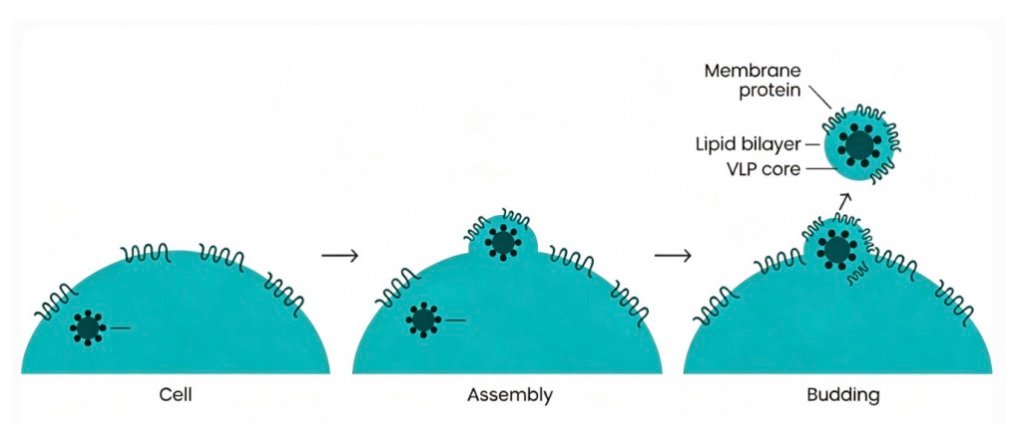
We produce enveloped virus-like particles that display your target transmembrane protein in a native phospholipid bilayer. The platform is built on HEK293 mammalian cell expression: producer cells are co-transfected with your target protein and HIV-1-derived gag polyprotein, which self-assembles at the plasma membrane and drives particle budding. The VLPs that emerge carry your protein of interest on their outer surface — full-length, correctly oriented, with native glycosylation and post-translational modifications intact. The particles are non-infectious and contain no viral genetic material. What you receive is a stable, soluble, characterizable reagent that presents your membrane protein the way it exists in a cell — not as an approximation of it.
📋 A streamlined workflow from gene to purified VLP.
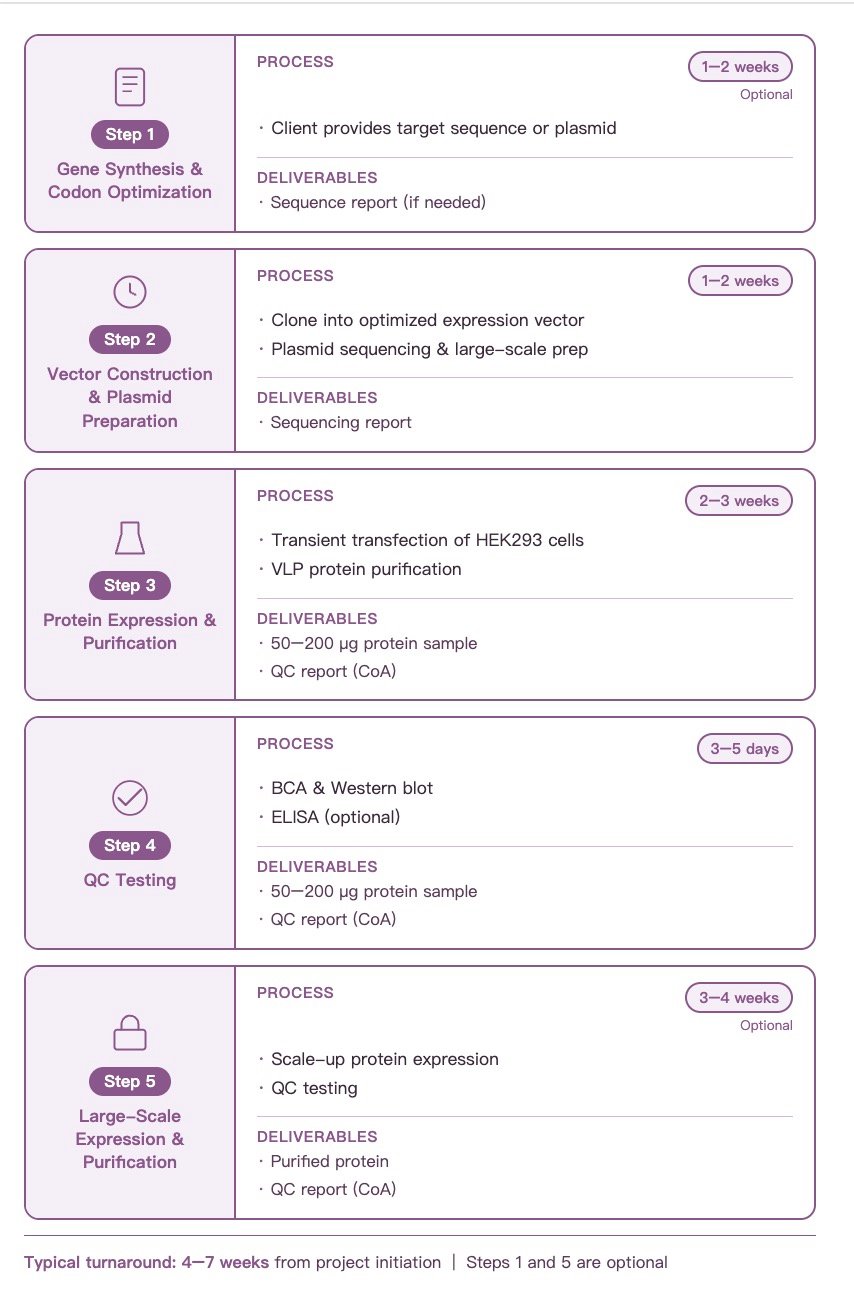
Standard turnaround for the full workflow is 4–7 weeks, with optional accelerated timelines available upon request.
Services Offered
Custom VLP Production
End-to-end production of VLPs displaying your target transmembrane protein, from construct design through purified particle delivery. Supported targets include GPCRs, claudins, ion channels, SLCs, viral envelope glycoproteins, and more.
Expression Optimization
For targets with no prior VLP display data, a dedicated optimization phase maximizes surface display efficiency and particle yield before preparative-scale production.
Scaled Preparative Production
Once display is confirmed, scale production to meet multi-animal immunization campaigns, large-format screening panels, or reagent banking.
VLP Characterization Package
Full biophysical & biochemical characterization including NTA, TEM, Western blot (gag + target), BCA total protein. Standalone service also available for VLPs produced elsewhere.
🔬 How VLPs display full-length transmembrane proteins.
The schematic below illustrates the core principle of the platform: target membrane proteins are co-expressed with viral structural proteins, incorporated into the budding particle, and presented on the VLP surface in their native lipid bilayer environment.
This architecture enables a range of applications where native membrane protein conformation is critical.
Applications
Antibody Discovery & Immunization
VLPs are an established immunogen format for raising antibodies against conformationally sensitive membrane targets. The particulate scaffold enhances immunogenicity, and the native lipid bilayer preserves the epitopes that matter most for therapeutic antibody programs.
Antibody Screening & Hit Confirmation
VLP preparations can be used directly in ELISA, flow cytometry-based binding assays, and hybridoma or phage display screening workflows to identify antibodies that recognize the native membrane-embedded conformation of your target.
Binding Assays & Target Characterization
VLP-displayed proteins support antigen-antibody interaction studies in plate-based and other binding assay formats, enabling characterization of candidates against targets that cannot be studied as purified soluble proteins.
Vaccine Antigen Development
For researchers developing immunization strategies against viral or tumor-associated membrane antigens, VLPs provide a non-infectious, scalable antigen presentation platform with intrinsic particulate adjuvant properties.
Deliverables
Typical turnaround: 4–7 weeks from project initiation (standard targets with confirmed expression; novel or difficult targets may require additional optimization time).
Get Started
Tell us your target, your application, and your timeline — we'll respond with a feasibility assessment and project proposal.
Contact BioCrest Sci📧 info@biocrest-sci.com | Custom VLP engineering from HEK293 platform