Neutralizing Antibody Production Service
BioCrest Sci provides neutralizing antibody production services for academic laboratories, biotechnology companies, vaccine developers, and pharmaceutical research teams requiring antibodies with functional blocking activity against specific biological targets.
Unlike standard binding antibodies, neutralizing antibodies are selected based not only on target recognition but also on their ability to inhibit biological activity such as:
- Receptor-ligand interaction
- Viral entry
- Cytokine signaling
- Enzyme activity
- Cell surface receptor activation
- Intracellular signaling pathways
We support custom neutralizing antibody development for:
Our antibody discovery workflows integrate antigen design, immunization strategy, recombinant antibody recovery, and functional neutralization screening to help researchers identify antibodies with biologically relevant activity.
Neutralizing antibodies are antibodies capable of blocking or interfering with the biological function of a target molecule or pathogen. While many antibodies bind their targets, only a subset demonstrate measurable inhibitory activity in functional assays.
Neutralizing antibodies may function by:
- Blocking receptor binding
- Inhibiting ligand interaction
- Preventing viral attachment or fusion
- Suppressing signaling pathway activation
- Inhibiting enzyme activity
- Sterically blocking functional epitopes
Because functional inhibition depends heavily on epitope specificity and assay design, neutralizing antibody discovery generally requires both binding-based and activity-based screening workflows.
Different antibody discovery technologies offer different advantages for neutralizing antibody generation depending on target complexity, timeline requirements, and downstream engineering goals.
BioCrest Sci provides multiple antibody discovery platforms for neutralizing antibody development.
Hybridoma-Based
Neutralizing Antibody Production
Workflow Overview: Antigen preparation & immunization → Serum titer monitoring → Splenocyte isolation → Hybridoma fusion → Binding-based screening → Functional neutralization screening → Clone selection & subcloning → Antibody purification & characterization
Common Applications: Receptor blocking antibodies, cytokine inhibition, cell signaling studies, diagnostic assay development, antiviral antibody discovery
Advantages: Stable monoclonal clones, renewable long-term production, established workflows, compatible with multiple functional assay formats
Single B-Cell
Neutralizing Antibody Discovery
Common Applications: Antiviral neutralizing antibodies, conformational epitope targeting, membrane protein targets, rapid recombinant antibody generation, therapeutic antibody discovery
Advantages: Faster recombinant antibody recovery, preserves native antibody pairing, strong compatibility with functional screening, suitable for rare antibody populations
Phage Display
Neutralizing Antibody Discovery
This platform is often used for: Difficult or toxic targets, affinity maturation, recombinant engineering, human or humanized antibody discovery, therapeutic antibody optimization
Advantages: Fully recombinant workflow, strong engineering flexibility, suitable for difficult antigen classes, compatible with affinity maturation workflows
| Platform | Main Advantages | Typical Timeline | Recombinant Compatible | Best-Fit Applications |
|---|---|---|---|---|
| Hybridoma Technology | Stable monoclonal clones | ~3-6 months | Optional | Cytokine blocking, receptor inhibition |
| Single B-Cell Screening | Rapid recombinant recovery | ~2-4 months | Yes | Antiviral and conformational epitope discovery |
| Phage Display | Engineering and affinity optimization | ~2-5 months | Yes | Therapeutic antibody discovery |
*Actual timelines vary depending on antigen immunogenicity, screening complexity, and functional assay requirements.
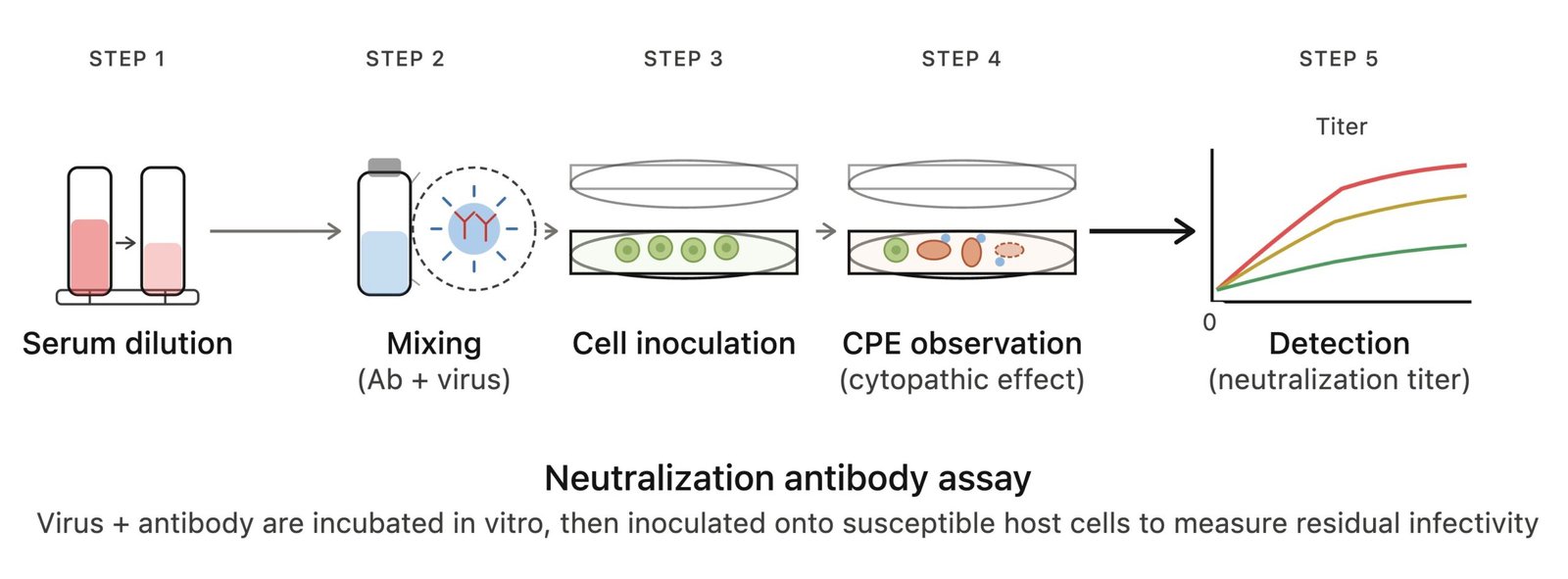
Neutralizing antibodies are typically evaluated through the neutralization assay, which measures their ability to inhibit viral infectivity in vitro. As illustrated in the workflow below, the process begins with serial dilution of patient serum, followed by incubation of the diluted antibodies with a standardized viral inoculum — allowing antibody–virus binding to occur. The mixture is then inoculated onto susceptible host systems, including cell monolayers, embryonated chicken eggs, or animal models. After incubation, cultures are examined for cytopathic effects (CPE) — morphological changes indicative of viral replication. Finally, residual infectivity is quantified and expressed as a neutralization titer (NT₅₀), reflecting the potency of the antibody response. A higher titer indicates stronger neutralizing immunity against the target virus.
- ▹ Antigen structure
- ▹ Biological mechanism
- ▹ Epitope accessibility
- ▹ Target pathway
- ▹ Animal immunization
- ▹ Recombinant library screening
- ▹ Single B-cell isolation
- ▹ Phage display selection
- ▹ ELISA
- ▹ Flow cytometry
- ▹ SPR/BLI
- ▹ Western blot
- ▹ Receptor blocking assays
- ▹ Virus neutralization
- ▹ Cell signaling inhibition
- ▹ Pseudovirus neutralization
- ▹ Affinity analysis
- ▹ Specificity testing
- ▹ Isotyping
- ▹ Sequence analysis
🔬 Multiple Neutralizing Antibody Discovery Platforms
We support hybridoma, single B-cell, recombinant, and phage display workflows for diverse functional antibody discovery programs.
🎯 Functional Screening-Oriented Development
Our workflows emphasize biological activity screening rather than relying solely on binding-based selection.
⚡ Support for Challenging Targets
We support antibody discovery against membrane proteins, viral antigens, cytokines, GPCRs, and difficult conformational epitopes.
🧪 Flexible Research Support
Projects may range from exploratory blocking antibody studies to advanced therapeutic antibody screening programs.
Binding antibodies recognize a target molecule, while neutralizing antibodies inhibit or block biological activity associated with that target.
Yes. We support neutralizing antibody discovery against viral surface proteins and related antigens using recombinant, hybridoma, and single B-cell workflows.
The optimal platform depends on target biology, timeline, assay requirements, and downstream applications. Single B-cell and phage display workflows are commonly used for recombinant therapeutic discovery, while hybridoma remains valuable for many research applications.
Yes. Recombinant recovery, sequencing, humanization support, and affinity optimization workflows can be integrated into neutralizing antibody development programs.
Start Your Neutralizing Antibody Discovery Project
If you are planning a neutralizing antibody development program, BioCrest Sci can help evaluate antigen strategy, platform selection, functional assay design, and downstream characterization requirements.
Contact Our Scientific Team →