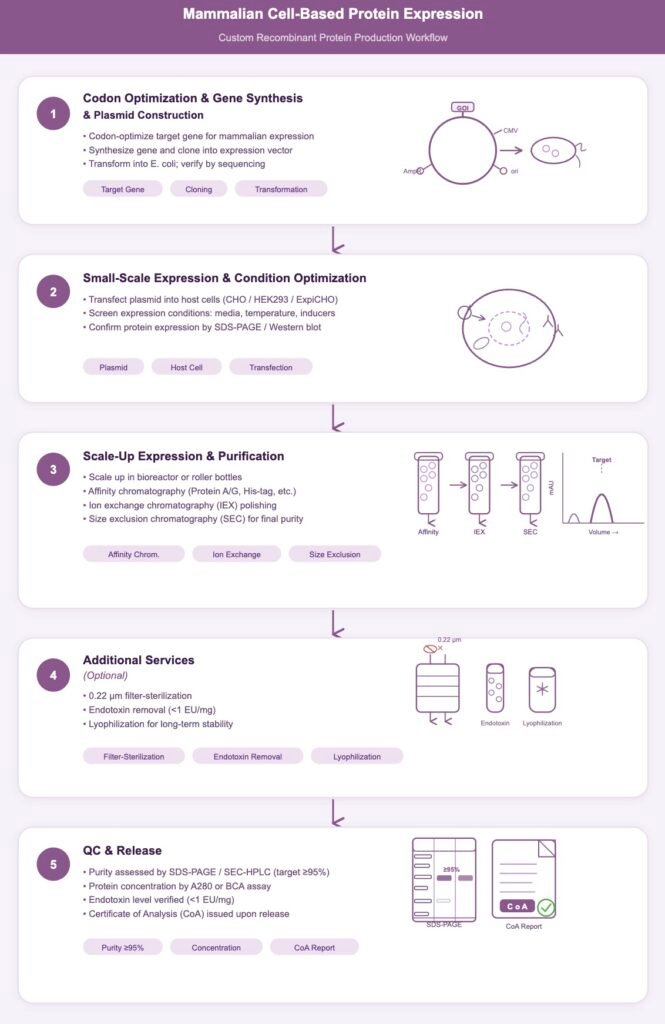
Mammalian Cell–Based Protein Expression
The Mammalian Protein Expression System is suitable for scientists’ needs for in vitro recombinant expression of natural conformational proteins, and is the system of choice for studying the function of specific proteins in the most physiologically relevant environment. This is because it allows for the highest level of post-translational processing of proteins and the highest level of functional activity, such as glycosylation modifications, phosphorylation modifications, and so on.
Biocrestsci has established a well-established system for lactation expression of recombinant proteins, including but not limited to FreeStyle 293-F cell line, Expi 293-F cell line, Expi-CHO-K1 and Expi CHO-S cell lines. Together with our improved promoters, secreted signal peptide sequences, vectors and transfection procedures, we are able to provide our customers with higher expression levels of recombinant protein mammalian cell expression and preparation.
Highlights
- Low cost, high yield, and easy to scale up
- More options for vectors and tags, higher success rate
- Optimized strategies for both soluble protein and inclusion bodies
- Have a clear genetic background
Service process
| Step | Service Item | Service Description | Timeline |
|---|---|---|---|
| 1 | Codon Optimization & Full Gene Synthesis & Plasmid Construction | Perform restriction digestion and ligation on the target fragment amplified by PCR, and successfully construct it into mainstream eukaryotic expression vector systems such as pSec, pCMV, and pCDNA | 8-11 working days |
| 2 | Small-scale Expression Optimization | Perform transient transfection of common host cells such as HEK293 and CHO in a small-volume system; simultaneously set up multiple groups of differentiated transfection conditions, and screen the optimal experimental scheme based on the detection results of protein expression levels | 3-5 working days |
| 3 | Scale-up Expression and Protein Purification | Based on the optimization results of the small-scale trial stage, select the suitable host cell line, and perform scale-up transfection in suspension or adherent culture mode; adopt multi-dimensional purification processes such as affinity chromatography, ion exchange, hydrophobic chromatography, and molecular sieve to finally obtain the high-purity target protein | 6-8 working days |
| 4 | Additional Services (Optional) | Provide a variety of personalized customized supporting services on demand, including tag removal by enzymatic digestion, aseptic processing, endotoxin content control, and protein vacuum lyophilization | 2-3 working days |
| 5 | Quality Inspection and Product Release | Complete comprehensive inspection of core quality indicators such as purity and concentration of the target protein, and issue a complete and standardized QC quality inspection report simultaneously | 3-5 working days |
| Total Project Timeline | 20-30 working days |
CHO cell line / HEK293 cell line differences
As the cells for mammalian cell expression need to grow stably and continuously and be able to be introduced by exogenous genes in order to achieve the expression of target genes, animal tissues need to be obtained through layers of screening and culture optimization. Commonly used cell lines include both HEK293 and CHO cells, both of which are cultured in suspension and can produce several grams of protein within a month.Biocrestsci has decades of experience and expertise in transient and stable expression based on HEK293 or CHO cell lines.
CHO Cells
CHO is the cell line of choice when developing commercial recombinant production of therapeutic proteins or therapeutic antibodies. Approximately 70% of approved biotherapeutic proteins are produced in stably transfected CHO cells, allowing for transient and stable expression. However, CHOs have the disadvantages of being finely difficult to transfect, low transfection efficiency, etc.
HEK293 Cells
HEK293, as a totipotent cell, has a significant role in virus production and recombinant protein production. Its ease of transfection, high level of protein expression and stable workflow make Human Embryonic Kidney 293 Cell (HEK293) the cell line of choice for transient protein transfection in mammalian cells.
Mammalian Cell–Based Protein Expression
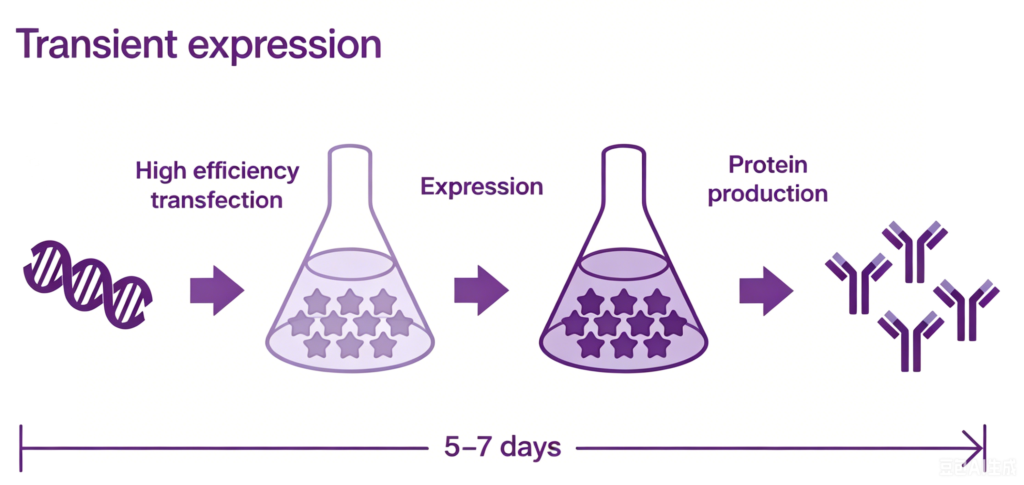
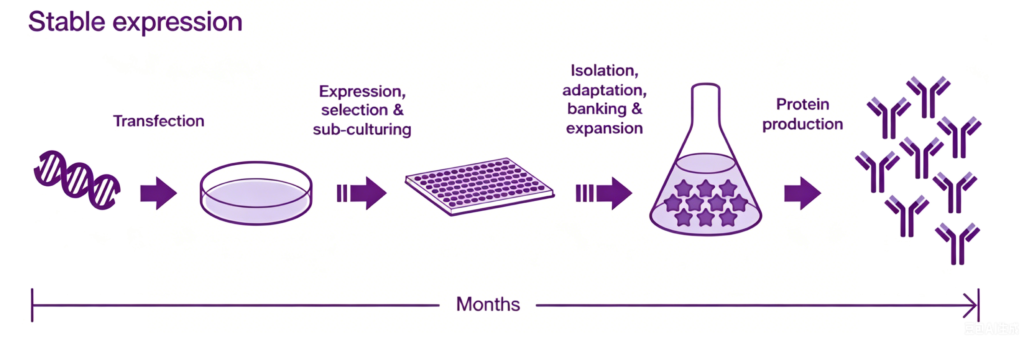
Mammalian cellular expression system with the advantage of being able to promote the correct folding of proteins and provide accurate glycosylation, acetylation and many other post-translational modifications. It enables the secretion of mature proteins into the extracellular compartment through the construction of signal peptides, and the use of affinity purification to obtain highly active proteins with relative ease. Based on the temporal and spatial differences in the expression of target proteins, mammalian cell expression systems can be categorized into transient, stable and inducible expression systems.
Transient expression
Stable expression
Mammalian Cell Expression workflow