About BioCrest Sci provides recombinant protein purification services for academic laboratories, biotechnology companies, diagnostic developers, and pharmaceutical research teams requiring purified recombinant proteins for downstream research and development applications.
Our purification workflows support recombinant proteins expressed in:
- E. coli
- Yeast expression systems
- Insect cells
- Mammalian cells
- Cell-free expression systems
We purify a broad range of recombinant protein classes, including:
- Enzymes
- Cytokines
- Growth factors
- Antibodies and antibody fragments
- Membrane proteins
- Viral antigens
- Receptor extracellular domains
- Fusion proteins
- Scaffold proteins
- Engineered recombinant proteins
Our recombinant protein purification services are commonly used for:
- Biochemical assays
- Structural biology
- Antibody production
- ELISA development
- Cell-based assays
- Biomarker validation
- Drug screening
- Protein interaction studies
- Vaccine research
- Therapeutic discovery workflows
Because recombinant proteins vary substantially in solubility, localization, stability, and post-translational processing, purification strategies are customized according to protein properties and downstream application requirements rather than using standardized generic workflows.
Protein purification workflows are designed based on expression system, protein localization, purification tags, structural complexity, and intended use.
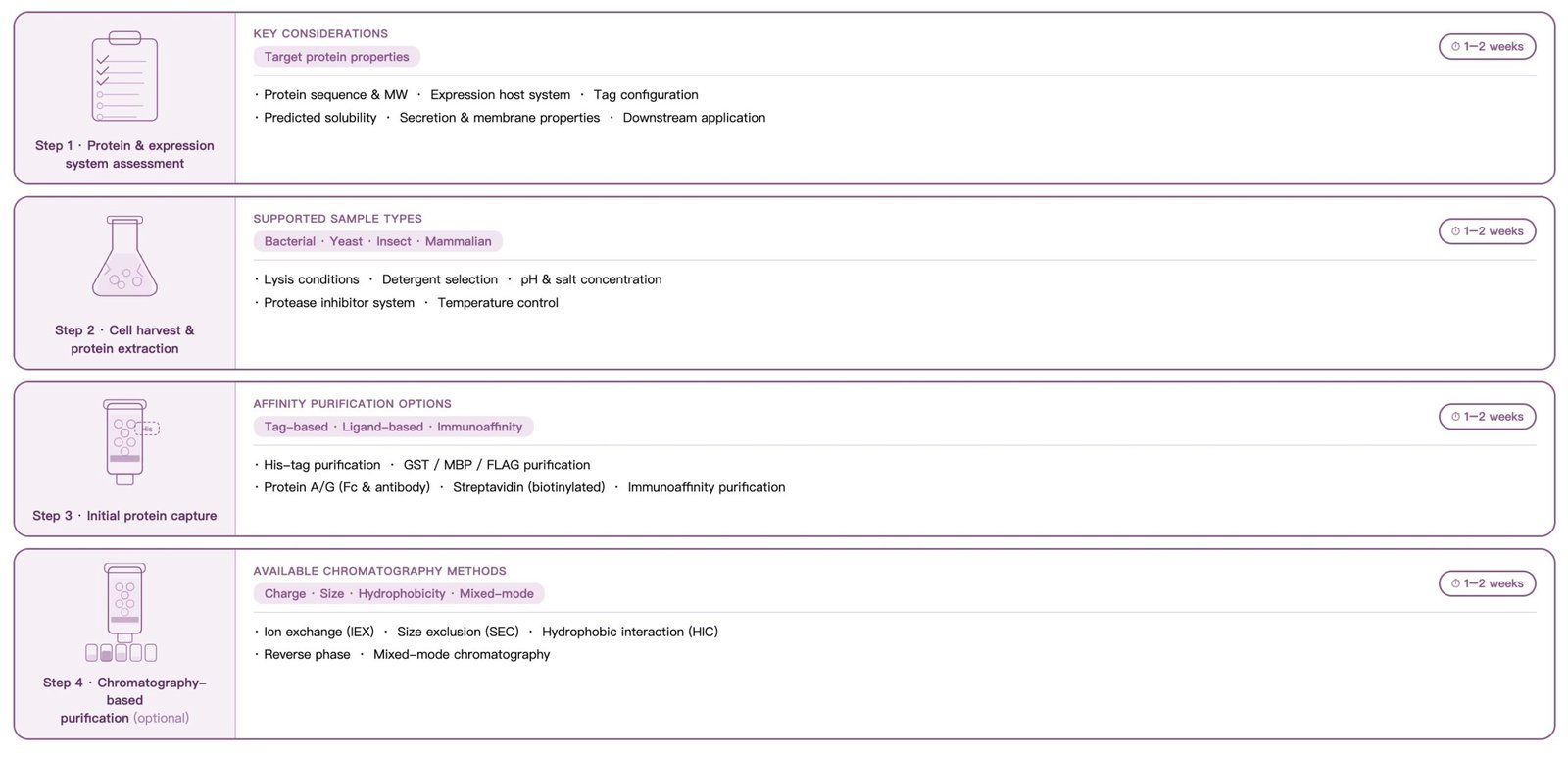
Soluble recombinant protein purification
For soluble proteins, purification workflows are optimized to preserve structural integrity and biological activity whenever possible.
Typical applications include:
- Enzyme studies
- Antibody production
- Receptor-ligand interaction assays
- Structural biology
Inclusion body purification and refolding
Some recombinant proteins expressed in bacterial systems accumulate as insoluble inclusion bodies.
About BioCrest Sci supports:
- Inclusion body isolation
- Denaturing purification
- Protein refolding optimization
- Aggregation reduction strategies
- Functional recovery evaluation
Refolding success varies depending on protein complexity, disulfide bond formation, and structural requirements.
Membrane proteins remain among the most technically challenging recombinant protein classes because they require careful solubilization and stabilization during purification.
We support purification of:
- GPCRs
- Ion channels
- Transporters
- Receptor complexes
- Viral membrane proteins
Available membrane protein strategies
- Detergent screening
- Mild solubilization workflows
- Lipid stabilization systems
- Nanodisc incorporation
- Affinity purification
- Low-temperature purification workflows
Actual recovery and stability depend heavily on target structure and expression characteristics.
For proteins secreted into culture media, purification workflows may include:
- Media clarification
- Ultrafiltration and concentration
- Affinity capture
- Polishing chromatography
- Endotoxin reduction
- Aggregate removal
Secreted expression systems are commonly used for:
- Cytokines
- Antibodies
- Fc-fusion proteins
- Growth factors
- Glycoproteins
Since the expression system directly impacts the protein's initial state (e.g., solubility, localization, modification pattern) and impurity profile (e.g., endotoxins, media components), purification strategies must be tailored accordingly.
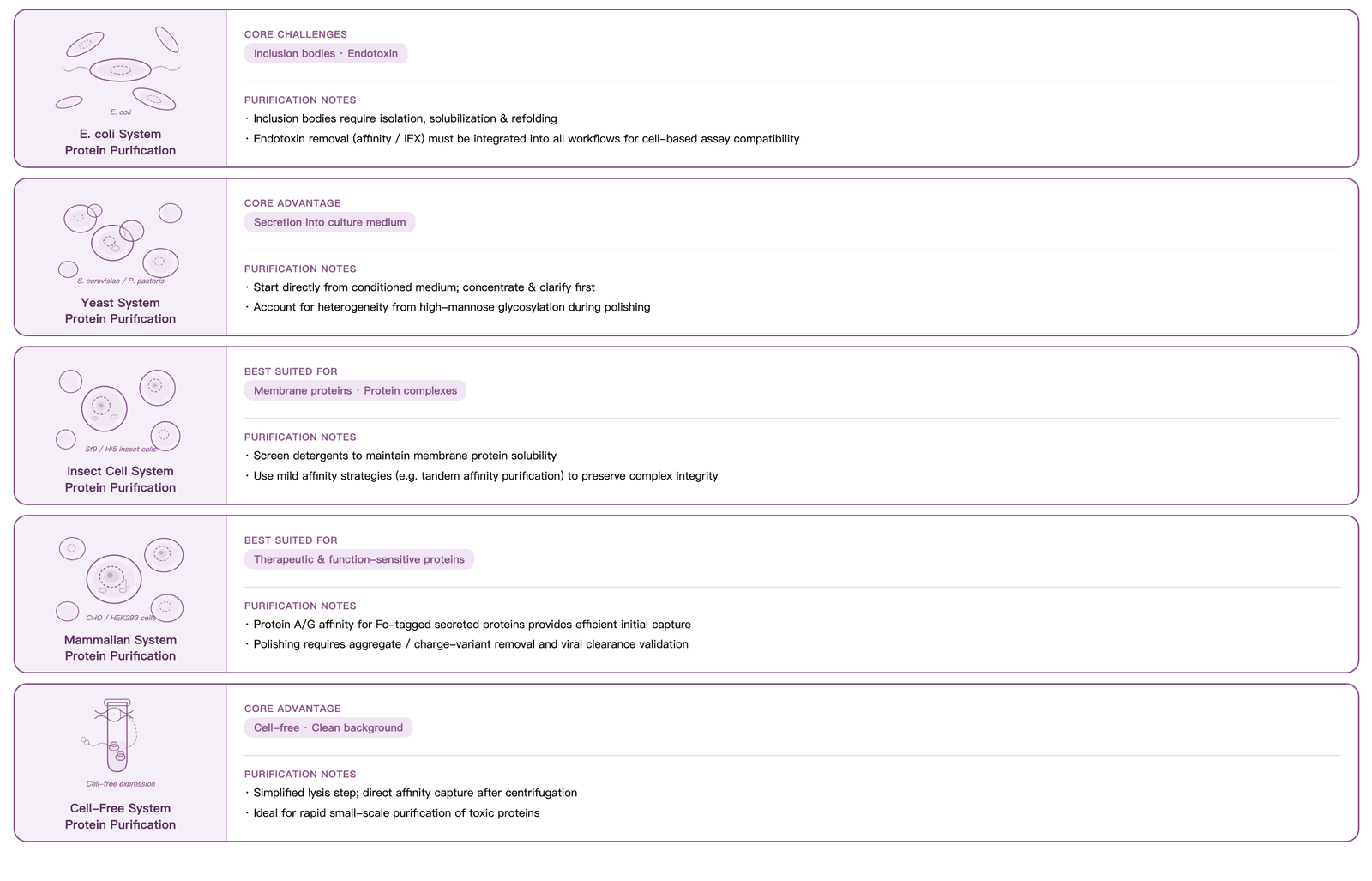
Purity and analytical requirements vary depending on downstream applications such as structural biology, immunization, biochemical assays, or therapeutic research.
| Analysis method | Typical purpose |
|---|---|
| SDS-PAGE | Purity assessment |
| Western blot | Protein identity confirmation |
| SEC-HPLC | Aggregate analysis |
| LC-MS | Molecular characterization |
| Endotoxin testing | Cell assay suitability |
| Protein concentration determination | Yield quantification |
| Activity assays | Functional validation |
| Glycosylation analysis | PTM characterization |
Additional analytical characterization may be customized according to project requirements.
For difficult proteins recovered under denaturing conditions, About BioCrest Sci offers protein refolding optimization workflows.
Refolding strategies may include
- Gradual dialysis
- Dilution refolding
- Redox-assisted refolding
- Additive screening
- Aggregation suppression optimization
Protein refolding outcomes vary significantly depending on structural complexity and folding requirements.
Recombinant protein purification outcomes depend heavily on:
- Expression level
- Protein stability
- Solubility
- Aggregation tendency
- Purification tag placement
- Host expression system
- Downstream assay requirements
Not all recombinant proteins behave similarly during purification, and some proteins may require iterative optimization of extraction, chromatography, or refolding conditions.
For certain proteins, alternative expression systems or construct redesign may improve purification performance.
We support recombinant protein purification from bacterial, yeast, insect, mammalian, and cell-free expression systems.
Purification workflows are tailored according to protein characteristics and downstream applications rather than relying on fixed purification templates.
We support membrane proteins, aggregation-prone proteins, inclusion body refolding, secreted proteins, and structurally sensitive targets.
In addition to purification, About BioCrest Sci supports recombinant protein expression, antibody development, protein characterization, and assay development workflows.
If you are planning a recombinant protein purification project, About BioCrest Sci can help evaluate protein characteristics, purification strategy, analytical requirements, and downstream application goals.
Contact our scientific team to discuss your recombinant protein purification project and technical development requirements.
Contact About BioCrest Sci