Custom Monoclonal Antibody Preparation Service
Biocrest Science provides custom antibody preparation services for university laboratories, biotech companies, diagnostic R&D institutions, and pharmaceutical research teams. We develop antibodies against recombinant proteins, peptides, membrane proteins, viral antigens, small molecules, and challenging targets.
We integrate mature hybridoma technology with modern antibody screening and characterization platforms. The antibodies we produce are widely applicable for: Western Blot (WB), ELISA and sandwich assay development, flow cytometry, immunofluorescence (IF), immunohistochemistry (IHC), neutralization and blocking assays, cell-based functional assays, biomarker validation, and early-stage drug discovery.
Our complete mAb development workflow covers antigen design, animal immunization, hybridoma generation, screening, subcloning, and antibody purification. Industry-leading service providers also incorporate recombinant expression, affinity ranking, and application-specific validation to ensure optimal antibody performance and experimental compatibility.
This service accommodates both exploratory basic research and long-term diagnostic assay development projects. We customize animal immunization and antibody screening strategies based on target biology and downstream applications, focusing on antibody specificity, sensitivity, epitope recognition, species cross-reactivity, native protein binding activity, low background performance, and batch-to-batch consistency.
Leveraging three core technology platforms (Hybridoma Technology, Single B‑Cell Screening, and Phage Display), we undertake custom mAb development projects for conventional antigens, recombinant proteins, complex membrane proteins, weakly immunogenic targets, and more — fully addressing diverse research and industrial needs.
Multiple Host Species Available
Select the optimal host based on antigen type, desired yield, and phylogenetic distance
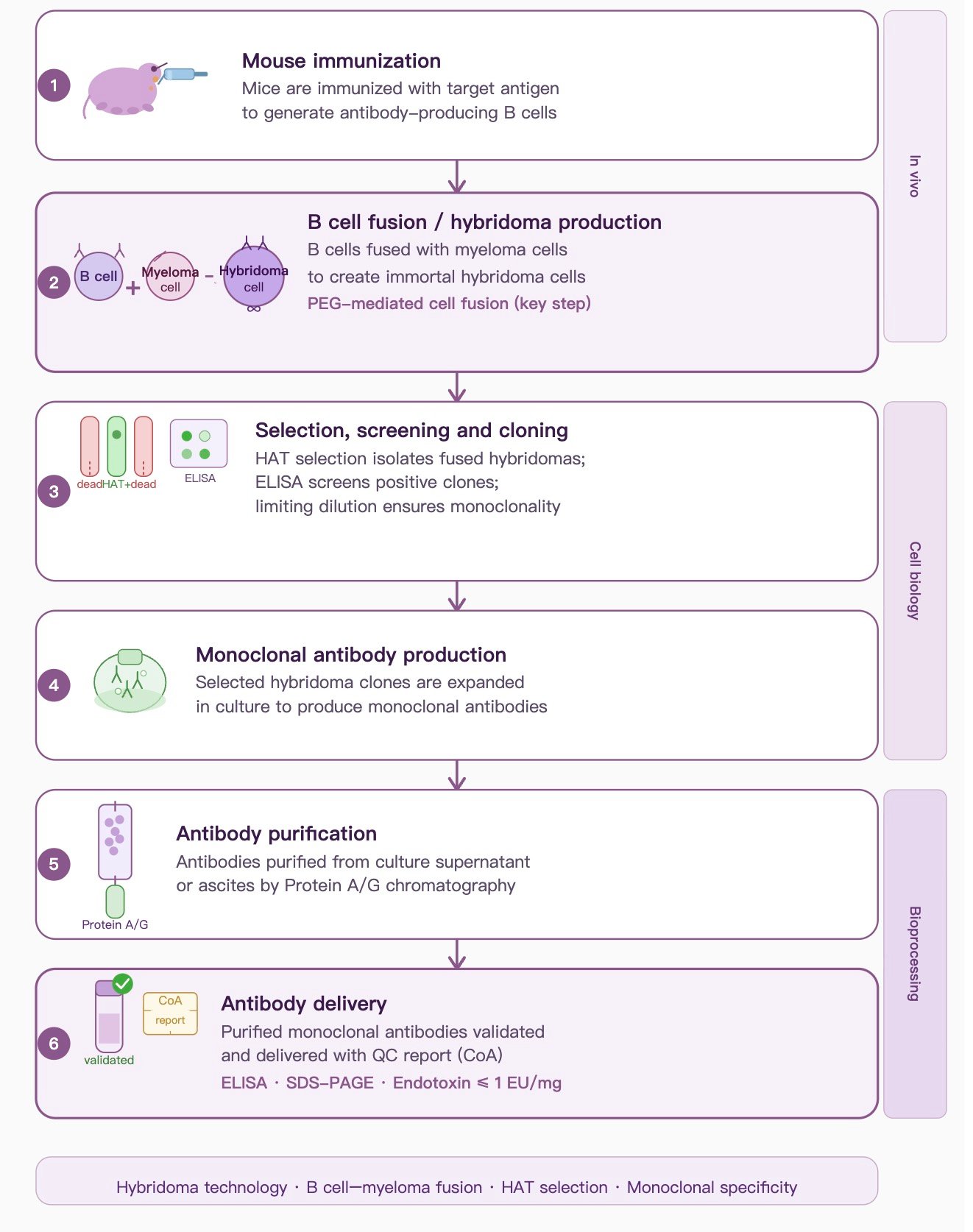
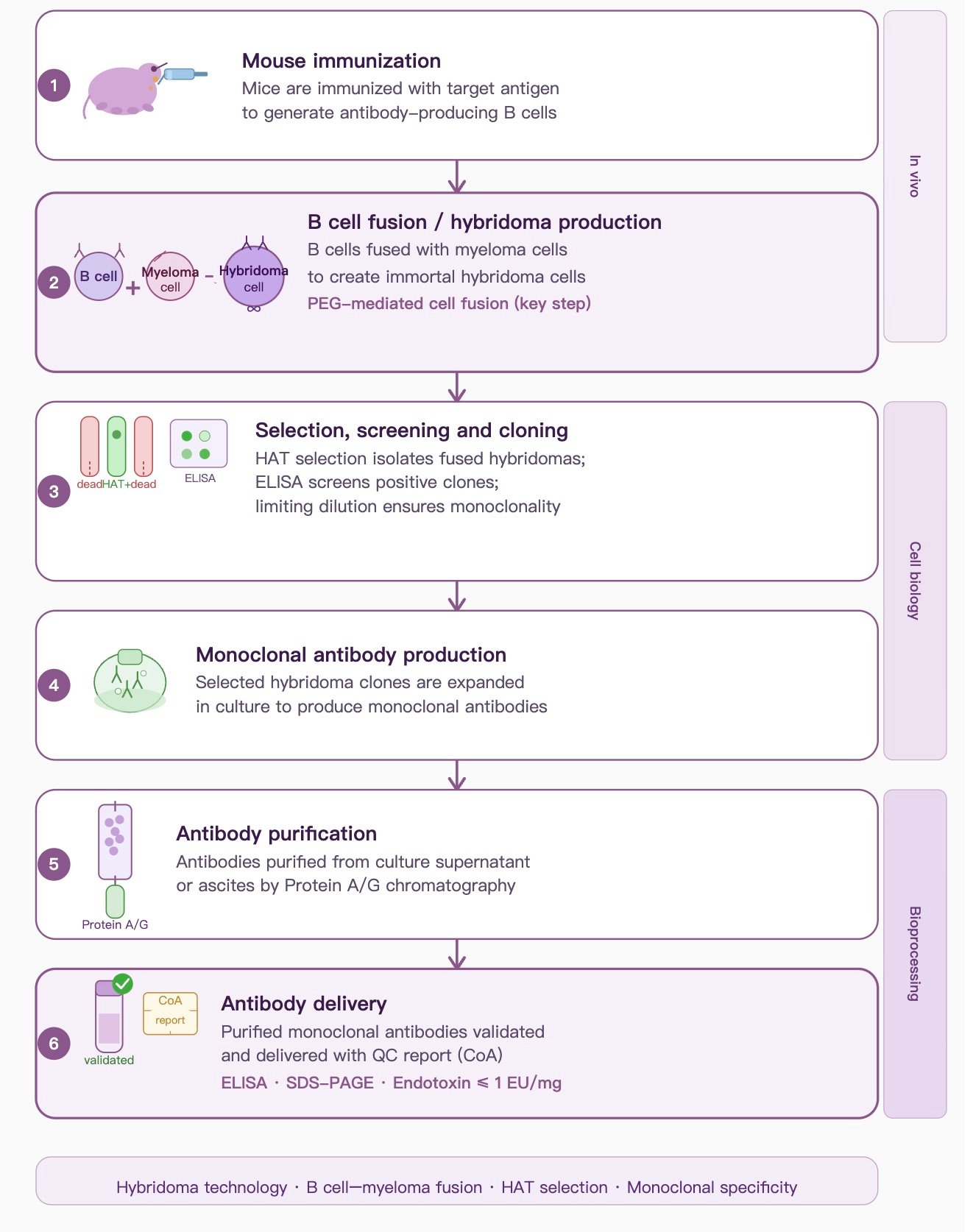
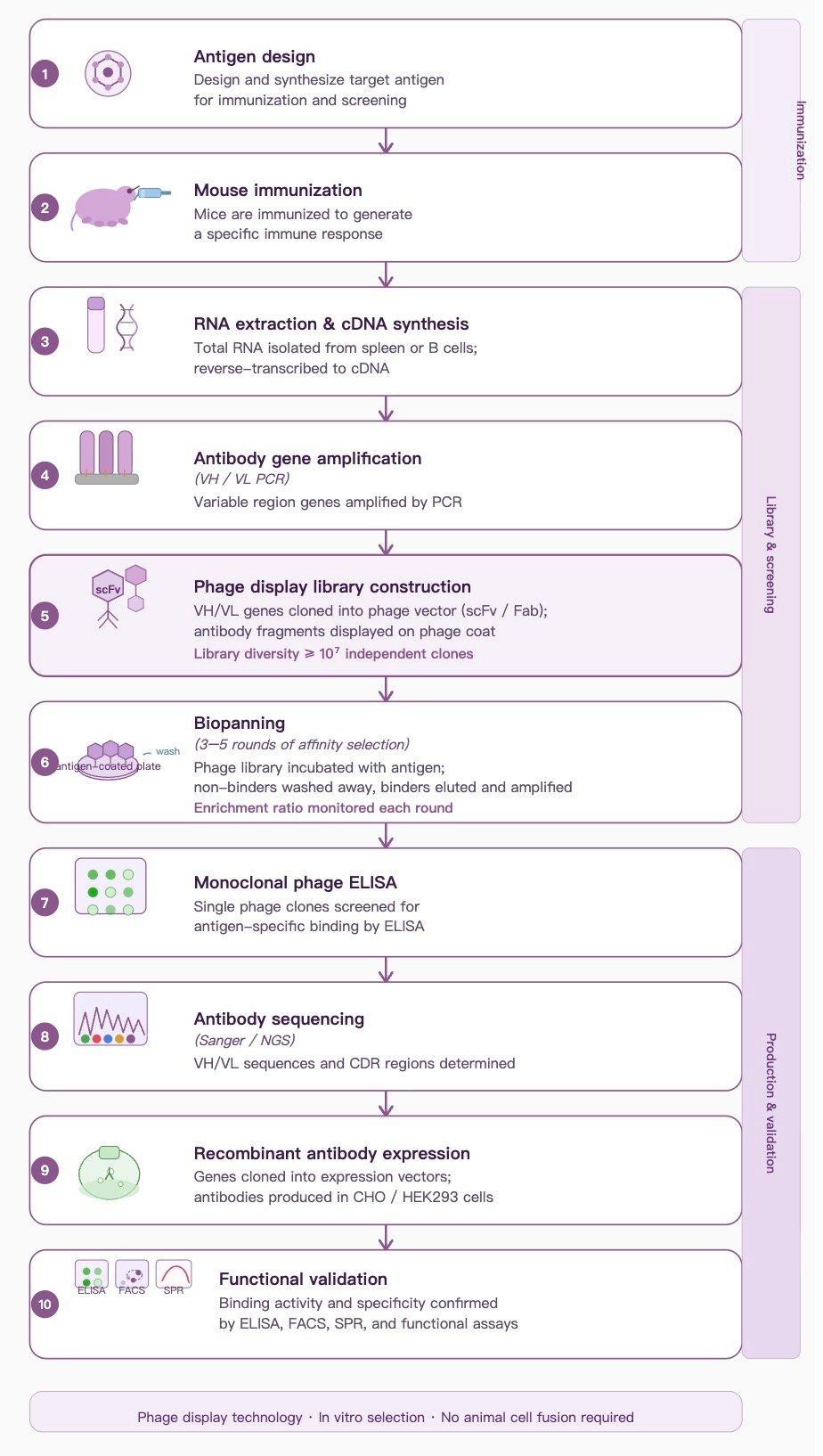
We develop monoclonal antibodies against a wide range of antigens: recombinant proteins, synthetic peptides, fusion proteins, membrane proteins, viral proteins, bacterial antigens, toxin‑associated proteins, cytokines and growth factors, phosphorylated peptides, haptens, and small molecules.
If customers have not yet completed antigen design, our scientific team can assist with epitope prediction, immunogenicity assessment, and immunization strategy optimization prior to project initiation.
Antibody performance heavily depends on screening strategies and downstream applications. We customize screening workflows based on customer experimental requirements.
| Validation Method | Application Purpose |
|---|---|
| ELISA | Initial binding activity screening |
| Western Blot (WB) | Denatured protein detection |
| Flow Cytometry | Cell surface binding detection |
| Immunofluorescence (ICC/IF) | Protein cellular localization |
| Immunohistochemistry (IHC) | Tissue section staining analysis |
| Neutralization Assay | Protein functional inhibition validation |
| Pairing Screening | Sandwich ELISA development |
| Affinity Analysis | Antibody binding characterization |
✅ Antibody performance varies across different experimental systems. Therefore, we implement application‑driven screening throughout the process to ensure antibodies are compatible with customers' actual experimental needs.
Depending on project scope, deliverables may include: positive hybridoma cell lines, purified monoclonal antibodies, antibody isotyping reports, raw ELISA screening data, cell‑based validation data, hybridoma cryopreservation samples, antibody sequencing reports, recombinant antibody expression materials, and small‑scale/large‑scale purified antibody products.
Actual project timelines vary based on antigen immunogenicity, screening complexity, and validation criteria.
Standard complete mAb development projects take approximately 3-6 months from project initiation to delivery of validated clones. Complex targets and advanced functional validation projects may require extended timelines.
Antibody generation is a biological R&D process subject to biological variability. We cannot guarantee that all immunization experiments will yield antibodies with expected specificity or functionality. To maximize project success rates, we implement quality checkpoints throughout the workflow: antigen integrity testing, serum titer monitoring, screening threshold optimization, clone stability assessment, microbial contamination testing, and final purified product QC.
For potential project risks, we have comprehensive contingency plans: alternative immunogen design, screening condition optimization, booster immunizations, and antibody engineering/refactoring.
Our custom mAb service supports diverse research fields: oncology, immunology, infectious diseases, neuroscience, stem cell biology, biomarker discovery, diagnostic assay development, drug target validation, and vaccine development.
- 1. Research‑Driven Custom Project Design — We reject rigid template workflows. Each project undergoes thorough technical assessment based on antigen characteristics, target biology, and downstream applications, resulting in a customized R&D plan.
- 2. Flexible & Diverse R&D Models — We support both standard mAb production and customized experimental workflows for challenging targets and special detection systems, accommodating diverse and high‑difficulty research needs.
- 3. Application‑Oriented Precision Validation — Screening strategies are designed around customers' actual experimental systems, ensuring antibody suitability from the start and significantly reducing subsequent assay development costs.
- 4. Full‑Stage Scalability — Services cover early exploratory experiments, mid‑stage sample validation, and large‑scale antibody production, with flexible R&D plans adjustable to project phase and scale.
- Q1: What materials are needed to start a custom mAb project?
Purified proteins, peptide antigens, DNA expression vectors, or complete antigen sequence information are sufficient to initiate a project. If customers do not have qualified antigens, we offer upstream antigen preparation and optimization services. - Q2: Can you develop monoclonal antibodies against membrane protein targets?
Yes. For complex membrane‑associated targets, we employ specialized strategies including peptide immunization, extracellular domain recombinant protein immunization, and whole‑cell immunization to efficiently overcome the challenges of membrane protein antibody generation. - Q3: Do you offer antibody sequencing services?
Yes. After screening and obtaining positive clones, we can perform full‑length antibody sequencing upon request for subsequent recombinant expression, antibody engineering, and long‑term cell line preservation. - Q4: Can you customize antibody validation for specific experimental applications?
Yes. We can design dedicated validation workflows tailored to specific applications including WB, ELISA, IHC, IF, flow cytometry, neutralization assays, and more.
Start Your Custom mAb Project
If you have plans for monoclonal antibody development, our scientific team can assist with antigen evaluation, screening strategy alignment, and project feasibility analysis prior to project initiation.
Contact Biocrest Science to discuss your custom monoclonal antibody requirements.
Contact UsTechnical workflows referenced from industry standards and publicly available technical resources of leading bioservice providers and biotech institutions.