CUSTOM SERVICES
Bacterial Protein
Expression Service
End-to-end E. coli recombinant protein production — from sequence to purified, QC-verified protein. We handle gene synthesis, construct optimization, expression screening, and affinity purification so you can focus on your science.
Expression System
Why E. coli — and when it's the right choice
E. coli remains the most widely used host for recombinant protein production for good reason: well-characterized genetics, fast doubling times, cost-effective media, and a straightforward path from clone to milligram-scale protein. It is particularly well-suited for prokaryotic proteins, cytoplasmic domains, antibody fragments, antigens, enzymes, and other targets that do not require eukaryotic post-translational modifications.
That said, bacterial expression is not universal. We will tell you upfront if your target — for example, a heavily glycosylated mammalian receptor or a protein requiring complex disulfide-bond networks — is unlikely to yield functional protein in E. coli, and recommend an alternative system when appropriate.
Fast turnaround
Typical gene-to-protein timeline of 4–6 weeks for standard soluble targets; extended timeline for difficult-to-express proteins or gram-scale production runs.
Scalable yield
From small-scale screening (50 mL) to multi-liter bioreactor runs. Yields vary by target but commonly reach milligrams to low grams of purified protein per liter.
Cost-effective
Lower per-milligram cost compared to insect or mammalian expression, making bacterial systems attractive for antigen production, structural studies, and assay development.
Well-validated
Decades of published literature, well-characterized strains (BL21, Rosetta, SHuffle), and standardized vectors provide a reliable technical foundation.
Our Edge
Our Service Advantages
Host & Vectors
Host System / Vector Selection
Commonly used recombinant protein expression plasmid vectors incorporate replicons, promoters, selection markers, MCS and fusion tag removal strategies. Prokaryotic expression vector: pET series (pET28a, pET30a, pET-24, etc.); pGEX Series; pETBlue; pCold; Modified vector pCES-SUMO; pCES-GST, etc.
By selecting suitable directing strains and conducting small amount induction detection of proteins, BioCrest Sci prokaryotic expression is commonly expressed in two hosts: Escherichia coli and Bacillus subtilis. The comparison between the two is as follows:
| Category | E. coli Expression Host | Bacillus subtilis Expression Host |
|---|---|---|
| Advantages | • Wide application, easy operation, low cost for large-scale production | • Low production cost, endotoxin-free, capable of secreting expressed proteins |
| Disadvantages | • Poor secretion capacity | • Relatively low yield |
| Common Hosts | • Rosetta (DE3), Rosetta(DE3) pLysS, Rosetta 2(DE3)pLysS, Origami 2(DE3), Rosetta-gami 2(DE3)pLysS | • WB600, WB800N, Bacillus Subtilis 168 |
Process
How the project runs
Every project follows a milestone-based workflow with a go/no-go checkpoint after small-scale expression. You are informed of results at each stage before we proceed to the next, so there are no surprises at delivery.
Quality & Deliverables
What you receive at project completion
FAQ
Common questions
What do I need to provide to get started?
A protein sequence (FASTA format) or GenBank accession number, your intended application (e.g., antigen for antibody development, enzyme for activity assays, structural biology), the desired purity level, and the quantity required. If you have a preferred tag, vector, or buffer, include those. We will handle everything else.
Can you express proteins from non-bacterial organisms?
Yes. We routinely express human, mouse, viral, and other eukaryotic sequences in E. coli using codon optimization to compensate for codon bias. However, eukaryotic proteins that require glycosylation or complex post-translational processing for correct folding and activity are better suited to insect or mammalian expression systems.
What is the minimum order quantity?
We can accommodate small-scale pilot projects producing as little as 0.5–1 mg of purified protein, through to gram-scale production runs for industrial or preclinical applications. Project scope and pricing scale accordingly.
What if expression screening fails to yield soluble protein?
If small-scale screening does not identify conditions producing adequate soluble protein, we will discuss the results with you transparently. Options include attempting inclusion body refolding, re-engineering the construct (different tag, truncation, or domain boundary), or advising on a transition to a eukaryotic expression system. We do not charge full project fees for targets where no detectable expression is observed.
Do you offer GMP-grade protein production?
Our standard service is for research-grade protein intended for non-clinical use. If you are working toward a regulated application and need GMP-grade material, please contact us to discuss requirements and capacity.
How do you ship the protein?
Purified protein is shipped on dry ice in aliquots, in the buffer specified during project scoping. Lyophilized format is available on request. We ship internationally; import requirements are the responsibility of the recipient.
Bacterial Expression Service Case Study
BIOCREST has extensive experience and expertise in protein expression purification and has successfully developed more than 7,000 recombinant proteins using E. coli expression systems, including hundreds of high-purity active proteins.
Case 1: Bacterial Protein expression in E. coli
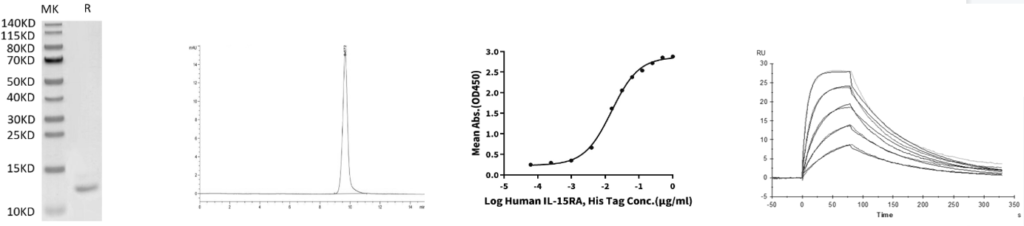
Human IL-15 on Bis-Tris PAGE under reduced condition. The purity is greater than 95%.
The purity of Human IL-15 is greater than 95% as determined by SEC-HPLC.
Immobilized Human IL-15, No Tag at 2 μg/ml (100 μl/Well) on the plate. Dose response curve for Human IL-15RA, His Tag with the EC50 of 15.4 ng/ml determined by ELISA.
Human IL-2 R beta, His Tag captured on CM5 Chip via Anti-His Antibody can bind Human IL-15, No Tag with an affinity constant of 5.9 nM as determined in SPR assay.
Case 2: Bacterial Protein expression in E. coli
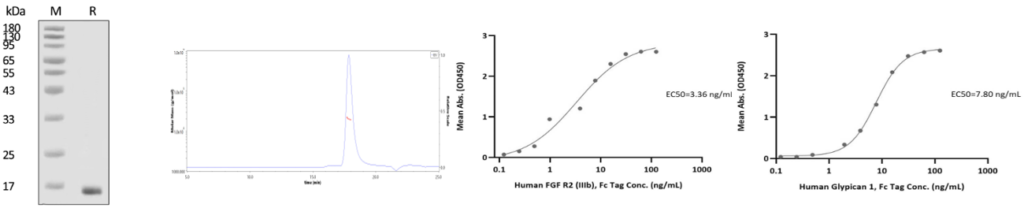
Human FGF basic (154aa) Protein, premium grade on SDS-PAGE under reducing (R) condition. The gel was stained with Coomassie Blue. The purity of the protein is greater than 95%.
The purity of Human FGF basic (154aa) Protein, premium grade is more than 90% and the molecular weight of this protein is around 15-25 kDa verified by SEC-MALS.
Immobilized Human FGF basic (154aa) Protein, premium grade at 2 μg/mL (100 μL/well) can bind Human FGF R2 (IIIb), Fc Tag with a linear range of 0.2-8 ng/mL.
Immobilized Human FGF basic (154aa) Protein, premium grade at 2 μg/mL (100 μL/well) can bind Human Glypican 1, Fc Tag with a linear range of 0.2-8 ng/mL.