Native Protein Purification Service
Isolation and Purification of Endogenous Proteins from Natural Biological Sources
BioCrest Sci provides native protein purification services for researchers requiring biologically active endogenous proteins isolated directly from natural tissues, cells, plasma, microbial cultures, or other biological materials. Unlike recombinant protein expression workflows, native protein purification focuses on isolating proteins in their naturally occurring state, including endogenous folding patterns, native post-translational modifications, physiological binding partners, and biologically relevant isoforms.
Our Native Protein Purification Services Support
- Enzyme purification
- Cytokine purification
- Plasma protein purification
- Tissue-derived protein isolation
- Receptor purification
- Protein complex enrichment
- Biomarker isolation
- Functional protein preparation
- Structural biology studies
For Researchers Requiring Native Proteins For
- Functional assays
- Activity studies
- Structural characterization
- Antibody generation
- Biomarker validation
- Drug screening
- Assay standardization
- Proteomics workflows
What Is Native Protein Purification?
Native protein purification refers to the isolation of proteins directly from biological sources while preserving their natural biochemical and structural properties as much as possible. Compared with recombinant proteins, native proteins may retain:
- Endogenous post-translational modifications
- Native glycosylation patterns
- Physiological folding states
- Protein-protein interactions
- Biologically relevant isoforms
- Authentic enzymatic activity
Native purification workflows are often used when recombinant systems cannot adequately reproduce biological activity or structural complexity.
Supported Biological Sources
BioCrest Sci supports native protein purification from a broad range of sample types.
- Tissue homogenates
- Cultured mammalian cells
- Plasma & serum
- Ascites fluid
- Immune cells
- Organ-derived extracts
- Bacterial cultures
- Yeast cultures
- Fungal biomass
- Leaf tissue
- Seed extracts
- Plant cell cultures
- Extracellular vesicles
- Conditioned media
- Inclusion body refolding prep
- Subcellular fractions
Sample suitability depends on target abundance, protein stability, and downstream application requirements.
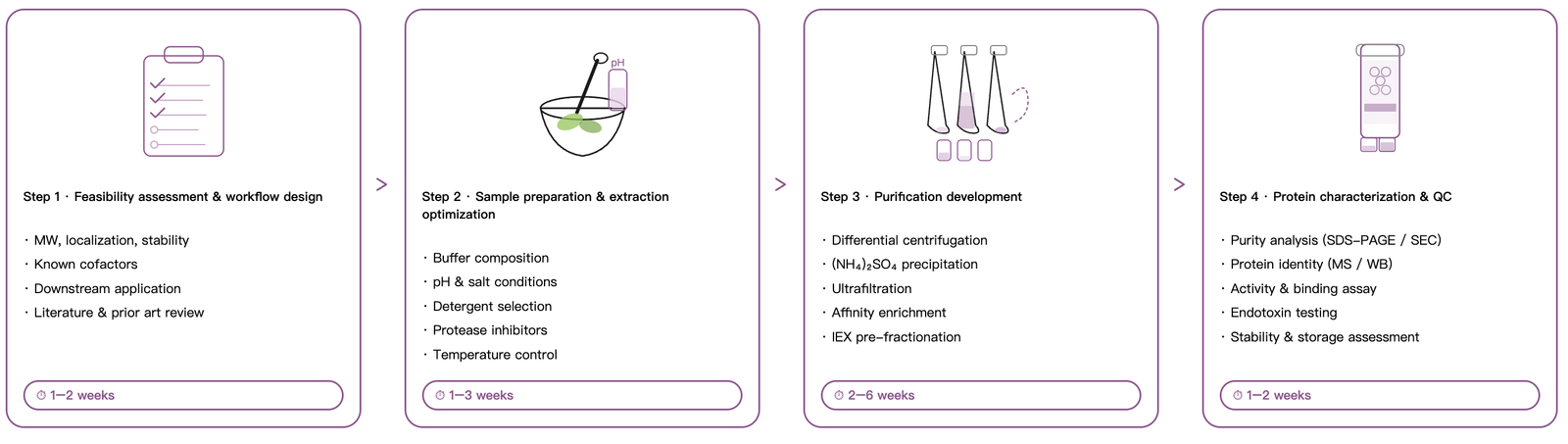
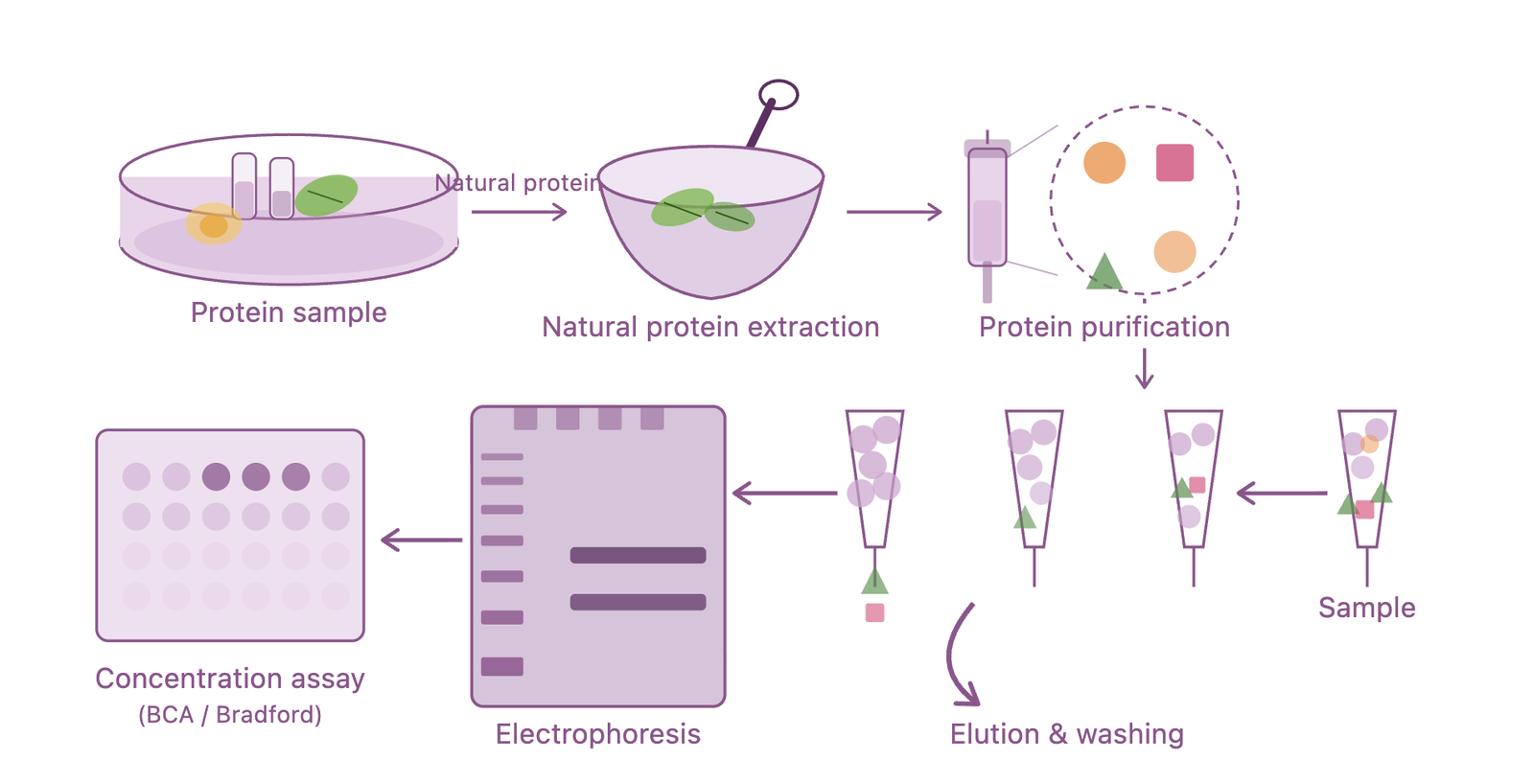
Native Protein Purification Workflow & Process
Because endogenous proteins vary substantially, purification workflows are customized for each target.
Available Purification Methods
| Method | Typical Purpose |
|---|---|
| Affinity Chromatography | Target-specific enrichment |
| Ion Exchange Chromatography | Charge-based separation |
| Size Exclusion Chromatography | Aggregate removal & polishing |
| Hydrophobic Interaction Chromatography | Hydrophobicity-based separation |
| Reverse Phase Chromatography | Analytical purification |
| Lectin Affinity Chromatography | Glycoprotein enrichment |
| Immunoprecipitation-Based Purification | Antibody-mediated target isolation |
Multi-step purification workflows are often required for low-abundance or highly complex targets.
Native Protein Purification for Functional Activity Studies
Many researchers choose native purification workflows because biological activity can depend on endogenous modifications and native folding. Applications commonly include:
- Enzyme kinetic studies
- Ligand binding analysis
- Receptor activation assays
- Structural biology
- Protein interaction analysis
- Cell signaling studies
Purification of Low-Abundance Proteins
Strategies may include immunoaffinity purification, tandem chromatography workflows, subcellular fractionation, large-volume starting material processing, and biomarker enrichment strategies. Recovery yields depend heavily on protein abundance, tissue source, and biochemical stability.
Protein Purity and Characterization Services
| Analysis Method | Typical Purpose |
|---|---|
| SDS-PAGE | Purity assessment |
| Western Blot | Identity confirmation |
| LC-MS/MS | Protein identification |
| Activity Assays | Functional evaluation |
| SEC-HPLC | Aggregation analysis |
| Endotoxin Testing | Cell assay suitability |
| Glycosylation Analysis | PTM characterization |
| Protein Concentration | Yield quantification |
Native vs Recombinant Protein Production
| Feature | Native Protein Purification | Recombinant Protein Expression |
|---|---|---|
| Protein Source | Natural biological material | Engineered host cells |
| Native PTMs | Preserved | Variable |
| Physiological Isoforms | Present | Often simplified |
| Scalability | Limited by source material | Often scalable |
| Purity Complexity | Higher purification complexity | More controlled expression |
| Suitable for Functional Studies | Strong advantage | Depends on expression system |
| Production Timeline | Variable | Often more predictable |
Why Researchers Work With BioCrest Sci
Customized Purification Strategies
Workflows designed according to target protein properties and downstream applications.
Support for Difficult Protein Classes
Low-abundance proteins, glycoproteins, enzyme complexes, and structurally sensitive targets.
Functional Activity-Oriented Workflows
Conditions optimized to preserve biological activity and native structural integrity.
Integrated Protein Science Capabilities
Recombinant expression, antibody generation, characterization, and assay development.
Frequently Asked Questions
Start Your Native Protein Purification Project
If you are planning a native protein isolation or endogenous protein purification project, BioCrest Sci can help evaluate target feasibility, purification strategy, analytical requirements, and downstream application goals.
Contact our scientific team to discuss your native protein purification project and experimental objectives.
© 2026 BioCrest Sci — Innovation in Protein Biochemistry