SPR / BLI Assay Services
Real-Time, Label-Free Interaction Analysis — When Endpoint Data Isn't Enough
For many programs, knowing whether two molecules bind is not enough. You need to know how fast they associate, how long the complex holds together, and how tightly they interact under near-physiological conditions. Surface Plasmon Resonance (SPR) and Bio-Layer Interferometry (BLI) are the two most established label-free, real-time optical biosensor technologies — without fluorescent tags that can perturb your molecule or introduce assay-specific artifacts.
At BioCrest Sci, we offer custom SPR and BLI assay development and analysis as a contract service, designed to fit your molecule type, your assay format, and your project stage. Whether you need a single kinetic measurement to support a patent filing, a high-throughput screen of antibody clones, or a fully developed method for ongoing QC use, our scientists design and execute the right experiment.
What SPR and BLI Measure
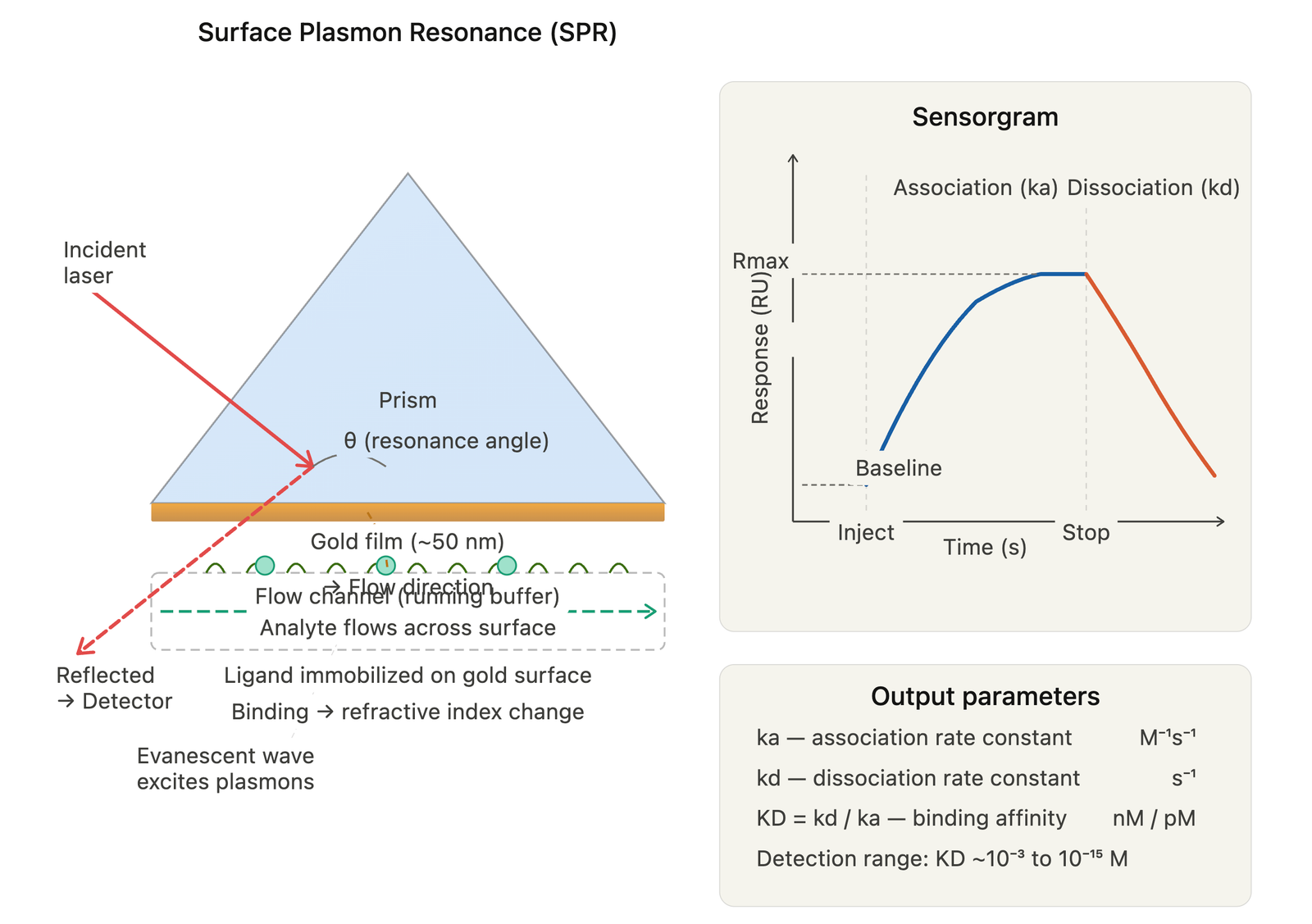
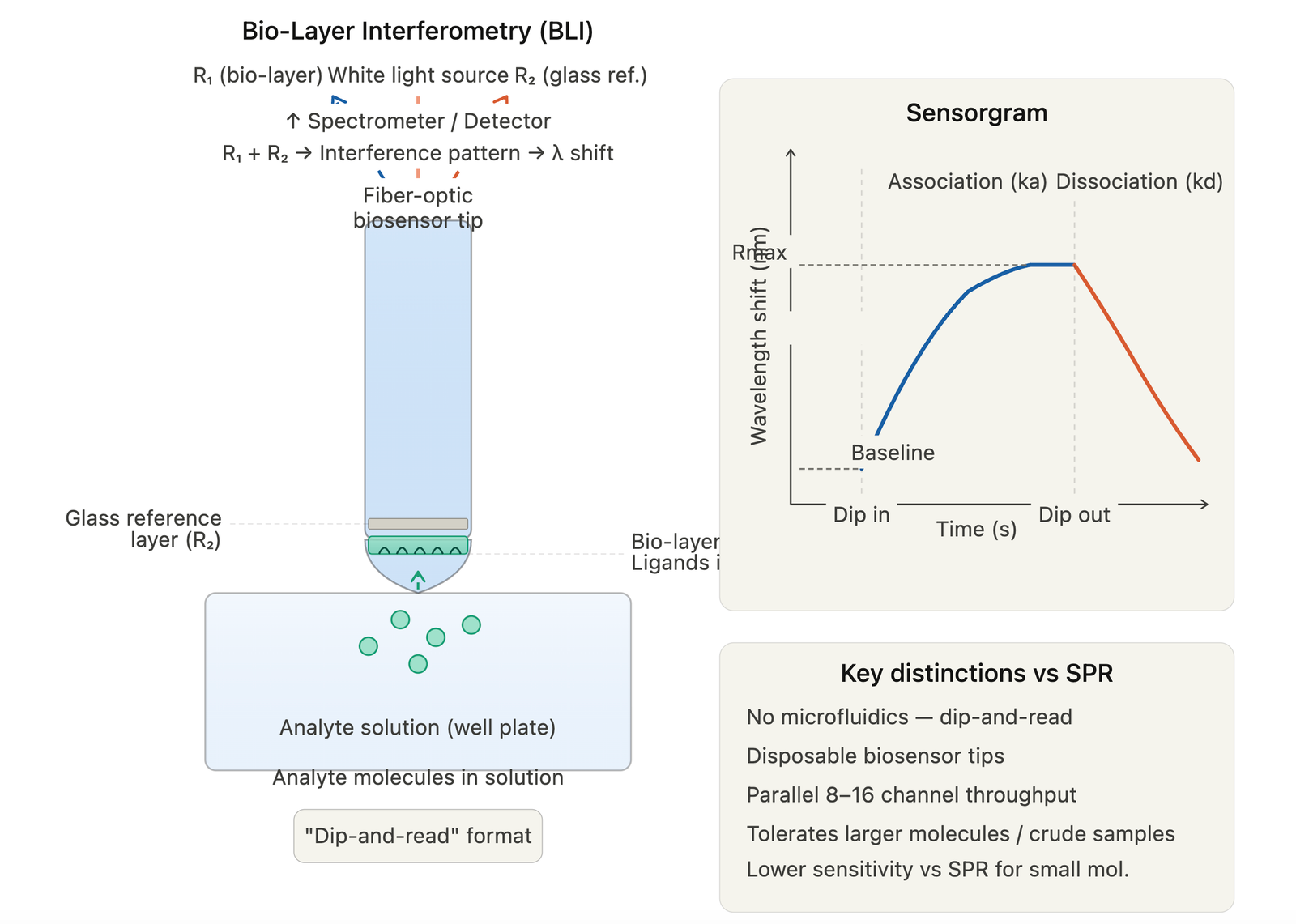
Both technologies immobilize one binding partner (the ligand) on a sensor surface and pass the other (the analyte) in solution over or around it. The instrument detects the change in optical signal at the sensor surface in real time — generating a sensorgram that captures the full binding event from injection through dissociation.
ka
Association rate constant (M⁻¹s⁻¹)
kd
Dissociation rate constant (s⁻¹)
KD
Equilibrium dissociation constant (kd/ka), reported in M, nM, or pM
Sensorgrams & fits
Full binding profiles, fit overlays, residual plots, and steady-state affinity plots.
These parameters support target engagement confirmation, lead ranking, selectivity profiling, Fc receptor characterization, and regulatory documentation for IND/BLA submissions.
SPR vs. BLI: How We Choose the Right Platform for Your Project
We don't default to one platform — we discuss your molecules, throughput needs, and precision required to make a biology-driven recommendation.
| Dimension | SPR — Surface Plasmon Resonance | BLI — Bio-Layer Interferometry |
|---|---|---|
| Detection principle | Refractive index change at a gold film surface, detected as a shift in resonance angle of reflected laser light | Optical thickness change at a biosensor tip, detected as a wavelength shift in the interference pattern of reflected white light |
| Instrument format | Microfluidic flow cell; analyte is continuously flowed over immobilized ligand on a sensor chip | Dip-and-read; biosensor tips are physically dipped into sample wells in a microplate |
| Sensitivity | High — suited for low-MW analytes (small molecules, fragments) and very high-affinity interactions at sub-pM KD | Moderate — generally sufficient for antibody-antigen interactions; may miss very low-MW or very high-affinity analytes |
| Affinity range (measurable KD) | ~10³ to 10¹⁵ M | ~10⁶ to 10¹² M; very tight or very weak binders may be outside reliable range |
| Throughput | Low-to-medium; sequential injections over one flow cell; HTP platforms (e.g. Carterra LSA) available for large arrays | Medium-to-high; 8–16 channels run in parallel per cycle; microplate format enables rapid clone screening |
| Sample requirements (purity & format) | Typically requires purified, well-characterized protein; crude samples risk fouling the flow cell surface | More tolerant of crude or partially purified samples (e.g. cell supernatants for clone triage); disposable tips reduce cross-contamination risk |
| Best suited for | Small molecule/fragment screening, high-precision kinetic characterization, Fc receptor binding panels, regulatory-grade affinity data — depth over speed | Antibody clone triage and ranking, high-throughput koff screening, epitope binning (large panels), concentration/titer determination — speed over depth |
| Focus Area | SPR | BLI |
|---|---|---|
| Primary strength | receptor binding panels, regulatory-grade affinity data — depth over speed | concentration/titer determination — speed over depth |
| Typical use in drug discovery | For many antibody programs, SPR and BLI are used together — BLI for early-stage clone triage, SPR for lead characterization. | |
Services Offered
Kinetic Affinity Measurement — full multi-cycle or single-cycle kinetic analysis with global fitting to 1:1 Langmuir or appropriate model.
koff Ranking — cost-effective single-concentration injection workflows for antibody discovery and fragment screening.
Epitope Binning — competitive/sandwich assays to classify antibodies into bins; dendrogram outputs.
Fc Receptor Panel — kinetics against FcγRI, FcγRIIa/b, FcγRIIIa/b, FcRn, C1q to support effector function characterization.
Concentration Determination — calibration-free concentration analysis (CFCA) by SPR or titration-based BLI quantitation.
Custom Assay Development — immobilization strategy, regeneration optimization, buffer compatibility, reference surface design.
Bispecific analysis — dual-binding or sequential binding assays to confirm simultaneous target engagement.
Supported Molecule Types
- Monoclonal antibodies (IgG1, IgG2, IgG4, IgM)
- Fab, F(ab')₂, scFv, VHH (nanobody) fragments
- Fusion proteins and Fc-fusion constructs
- ADC constructs (kinetics of antibody component)
- Recombinant proteins and antigen targets
- Peptides (small analytes on high-density surfaces)
- Small molecules and fragments (requires DMSO solvent correction)
- Nucleic acids (DNA, RNA)
- VLPs and other large particulate analytes (BLI preferred)
Note: Membrane proteins, highly hydrophobic molecules, and intrinsically disordered proteins may present additional challenges. Please contact us to discuss feasibility.
Sample Requirements
Before project initiation, we ask for: protein identity, molecular weight, tags, buffer composition, storage conditions, approximate concentration/volume, purity estimate (SDS-PAGE or SEC preferred), and known stability concerns.
| Molecule Role | Minimum Required Amount | Recommended Concentration |
|---|---|---|
| Ligand (to be immobilized) | 50–200 µg | 0.1–1 mg/mL |
| Analyte (in solution) | Depends on conc. series; generally 200–500 µL working stock | Per method guidance |
| Small molecule analyte | 5–10 mg | Sufficient for DMSO stock and dilution series |
Insufficient purity or significant aggregation are the most common causes of assay failure and will be flagged before instrument time is consumed.
Workflow Overview
Review molecule types, goals, samples. Platform recommendation and quote.
Visual inspection, A280, SEC/DLS if needed.
Immobilization, reference surface, pilot injections.
Full kinetic/steady-state runs with reference subtraction.
Processed sensorgrams, kinetic fits, parameter table, summary report, raw data.
Deliverables
- Processed sensorgrams (reference-subtracted)
- Kinetic or steady-state fit overlays
- Summary table of kinetic and affinity parameters (ka, kd, KD, Rmax, chi²)
- Brief written report covering assay design, instrument settings, and data quality notes
- Raw data export files
- For custom assay development: validated method document
Frequently Asked Questions
❓ My protein is somewhat heterogeneous. Can I still get useful data?
It depends. Aggregates complicate fitting. We assess your sample and discuss realistic outcomes. In some cases, capture-based approaches mitigate heterogeneity effects.
❓ Do I need purified protein, or can you work with crude supernatant?
BLI workflows can accommodate clarified supernatants for some applications (e.g., clone triage). SPR typically requires higher purity. Discuss during consultation.
❓ Can you run DMSO solvent correction for small molecule analytes?
Yes. For SPR analysis of small molecules, we include a solvent correction series as standard.
❓ What fitting model do you use?
We default to 1:1 Langmuir for most interactions. For biphasic or heterogeneous kinetics, we discuss alternative approaches and present data transparently.
❓ Will the assay always work?
We cannot guarantee every assay yields interpretable kinetics. Factors such as protein instability, very fast/slow kinetics, or heterogeneous binding may limit measurements. We raise risks during scoping and report honestly.
Why Work With BioCrest Sci
- Experienced scientists across therapeutic antibodies, bispecifics, small molecules, complex biologics
- Transparent communication about assay feasibility and data quality
- Flexible project scope — from single measurement to multi-panel characterization campaigns
- Raw data provided as standard, keeping full analytical control with your team
- Competitive pricing structured around project scope, not instrument-hour billing
Get Started
To request a quote or discuss your project, contact our team with a brief description of your molecule types, assay goals, and approximate sample availability. We will respond with a feasibility assessment and project proposal.
Contact BioCrest Sci