Tagged Fusion Protein Purification Services
- Improve purification efficiency
- Increase protein solubility
- Enhance detection sensitivity
- Maintain expression stability
- Improve downstream assay compatibility
Because fusion proteins can differ substantially in expression level, solubility, aggregation tendency, and structural stability, purification workflows are customized according to target protein properties and downstream application requirements.
Different fusion tags offer distinct advantages depending on protein characteristics and experimental goals.
| Fusion Tag | Typical Purpose | Key Advantages | Common Considerations | Purification Method | Amino Acid Sequence |
|---|---|---|---|---|---|
| His | General recombinant purification | Straightforward workflow; compatible with multiple expression systems; relatively small tag; suitable for many downstream assays | May co-purify contaminants | Ni-NTA affinity chromatography; cobalt affinity chromatography; IMAC polishing workflows | HHHHHHH |
| GST | Solubility & pull-down assays | Improves solubility of certain recombinant proteins; affinity purification compatibility; useful for interaction studies | Larger fusion partner (211 aa) | Glutathione affinity chromatography | 211 aa (full-length sequence) |
| MBP | Solubility enhancement | Enhances solubility of difficult proteins; improves folding in some constructs; compatible with bacterial systems | Large tag (396 aa) may affect activity | Amylose affinity chromatography | 396 aa (full-length sequence) |
| FLAG | Detection & mammalian workflows | Small epitope tag; suitable for mammalian recombinant proteins; immunoprecipitation & localization studies | Lower purification capacity | Anti-FLAG affinity purification | DYKDDDDK |
| Fc | Stability & secretion efficiency | High purification efficiency; improves protein stability, secretion and half-life; suitable for receptor ectodomains, cytokines | Large fusion construct | Protein A chromatography; Protein G chromatography | IgG Fc fragment (sequence varies by species/isotype) |
| Strep | Mild purification conditions | High specificity; suitable for sensitive protein complexes and structural biology; low-background purification | Lower binding capacity in some systems | Strep-Tactin affinity chromatography | Strep-tag II: WSHPQFEK |
| SUMO | Enhanced expression & correct folding | Promotes proper folding of difficult proteins; specific cleavage by SUMO protease leaves native N-terminus | Tag size ~100 aa; protease removal needed | SUMO affinity system (or dual-tag strategy) | ~100 aa (commonly yeast/human SUMO sequence) |
Selection of the optimal tag depends on expression system, target protein properties, downstream assays, and purification goals.
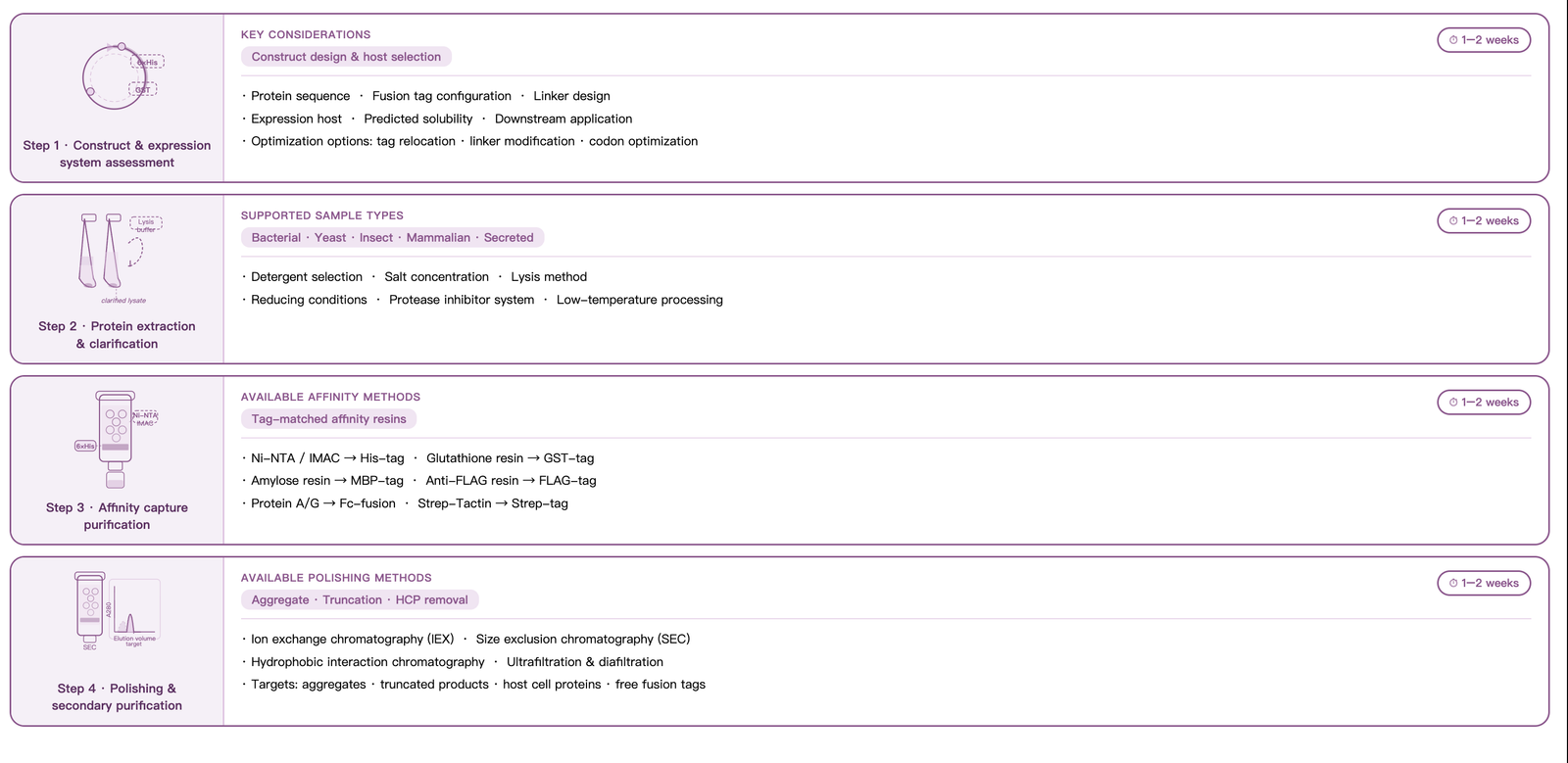
For applications requiring native or minimally modified proteins, fusion tag cleavage workflows may be incorporated.
Common Protease Cleavage Systems
- TEV protease
- Thrombin
- Enterokinase
- Factor Xa
- SUMO protease
Following cleavage, secondary purification separates:
- Target protein
- Cleaved fusion tag
- Residual protease
- Uncleaved fusion protein
Tag removal efficiency depends on protein structure and cleavage site accessibility.
Common Challenges
- Aggregation
- Inclusion body formation
- Proteolytic degradation
- Low solubility
- Membrane association
- Multimerization
Optimization Strategies
- Low-temperature expression support
- Detergent screening
- Refolding optimization
- Buffer screening
- Cofactor stabilization
- Alternative purification conditions
| Analysis Method | Typical Purpose |
|---|---|
| SDS-PAGE | Purity assessment |
| Western Blot | Tag and protein confirmation |
| SEC-HPLC | Aggregate analysis |
| LC-MS | Molecular characterization |
| Endotoxin Testing | Cell assay suitability |
| Protein Concentration Determination | Yield analysis |
| Activity Assays | Functional validation |
Additional analytical workflows may be customized according to project requirements. Complex membrane proteins, inclusion body refolding projects, or multi-step polishing workflows may require additional optimization time.
Tagged fusion proteins can behave differently depending on: tag position, linker design, protein folding, expression host, purification conditions, and downstream assay requirements.
In some cases, fusion tags may affect: enzymatic activity, protein conformation, binding interactions, or oligomerization behavior. For sensitive applications, tag cleavage or alternative construct design may be recommended.
- Support for Multiple Fusion Tag Systems — His, GST, MBP, FLAG, Fc, Strep, SUMO, GFP and custom constructs.
- Customized Purification Strategies — Optimized according to target protein properties and downstream applications.
- Support for Difficult Recombinant Proteins — Aggregation-prone, membrane proteins, inclusion body refolding, and structurally sensitive fusion proteins.
- Integrated Protein Science Services — Recombinant expression, native protein purification, antibody generation, and characterization.
Start Your Tagged Fusion Protein Purification Project
If you are planning a tagged recombinant protein purification project, BioCrest Sci can help evaluate fusion construct design, purification strategy, analytical requirements, and downstream application goals.
Contact Our Scientific Team →Discuss your tagged fusion protein purification project and technical development requirements.