Detergent Platform — Displayed Transmembrane Proteins
Transmembrane proteins govern some of the most critical processes in cell biology — signal transduction, ion transport, metabolite uptake — and represent a disproportionate share of validated drug targets. Getting them out of the membrane in a form that is stable, pure, and functionally relevant is where most programs run into trouble. BioCrest Sci's Detergent Platform provides custom extraction, solubilization, and purification of transmembrane proteins using carefully selected detergent systems, giving you purified material that retains native-like conformation and is ready for downstream use.
The Challenge
Transmembrane proteins cannot simply be expressed and purified like soluble proteins. Their hydrophobic transmembrane domains are anchored in the lipid bilayer, and removing them from that environment without disrupting their structure is far from straightforward. Too harsh a detergent and the protein unfolds, aggregates, or loses its binding activity. Too mild and solubilization is incomplete. Add to this the challenge of low expression yields, instability in solution, and the need to maintain detergent compatibility throughout every purification step — and it becomes clear why so many labs struggle to generate usable transmembrane protein material in-house.
What Is the Detergent Platform?
The Detergent Platform refers to a systematic approach to transmembrane protein production in which detergents — amphiphilic molecules with both hydrophilic and hydrophobic regions — are used to extract proteins from cell membranes and keep them stable in aqueous solution. At concentrations above their critical micelle concentration (CMC), detergent molecules form micelles that encapsulate the hydrophobic transmembrane domains of the target protein, effectively replacing the lipid bilayer and allowing the protein to remain soluble and structurally intact outside the membrane.
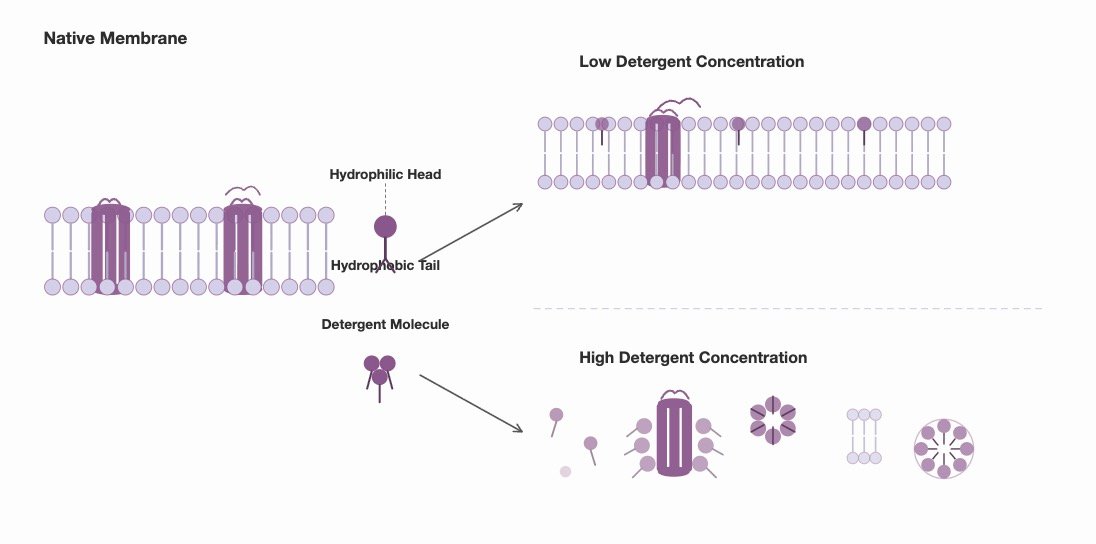
💡 How detergents work: Below CMC, detergents only partially disrupt the lipid bilayer; above CMC, micelles form and encapsulate hydrophobic transmembrane domains, releasing the protein in a soluble, native-like state. This principle drives the entire solubilization process.
The choice of detergent is critical. Mild non-ionic detergents such as DDM (n-dodecyl-β-D-maltoside), LMNG (lauryl maltose neopentyl glycol), and digitonin or its synthetic analog GDN are most commonly used for proteins where preserving native conformation and ligand-binding activity is essential. Harsher detergents may be appropriate for denaturation-tolerant applications such as antigen preparation for certain immunization strategies. At BioCrest Sci, we screen and select the most appropriate detergent for your specific target and application — rather than applying a one-size-fits-all approach.
Services Offered
Detergent Screening & Solubilization Optimization
Systematic screen of mild detergents (DDM, LMNG, GDN, digitonin) to maximize solubilization efficiency and stability.
Output: Recommended detergent, efficiency data, preliminary stability assessment.
Transmembrane Protein Expression & Extraction
Full-service expression in HEK293 or Sf9 insect cells, membrane isolation, detergent extraction. Optimized construct design.
Supported targets: GPCRs, ion channels, SLC transporters, claudins, viral membrane proteins.
Affinity Purification & Polishing
Affinity chromatography (His, FLAG, Strep) + size-exclusion chromatography (SEC). Detergent compatibility maintained throughout.
Lipid Supplementation & Stabilization
Supplementation with CHS or other lipids during extraction/purification to stabilize challenging targets (GPCRs, etc.).
Custom Full-Service Production
End-to-end: construct design → expression → detergent screening → purification → characterization, with regular updates.
➡︎ From gene to purified protein — a streamlined workflow
To ensure transparency and reproducibility, every custom project follows a well-defined stepwise process. The diagram below outlines our end-to-end production pipeline for detergent-solubilized transmembrane proteins, from initial gene synthesis to QC-approved purified material. Optional steps (gene synthesis and final large-scale validation) are tailored to your specific needs while maintaining rapid turnaround times.
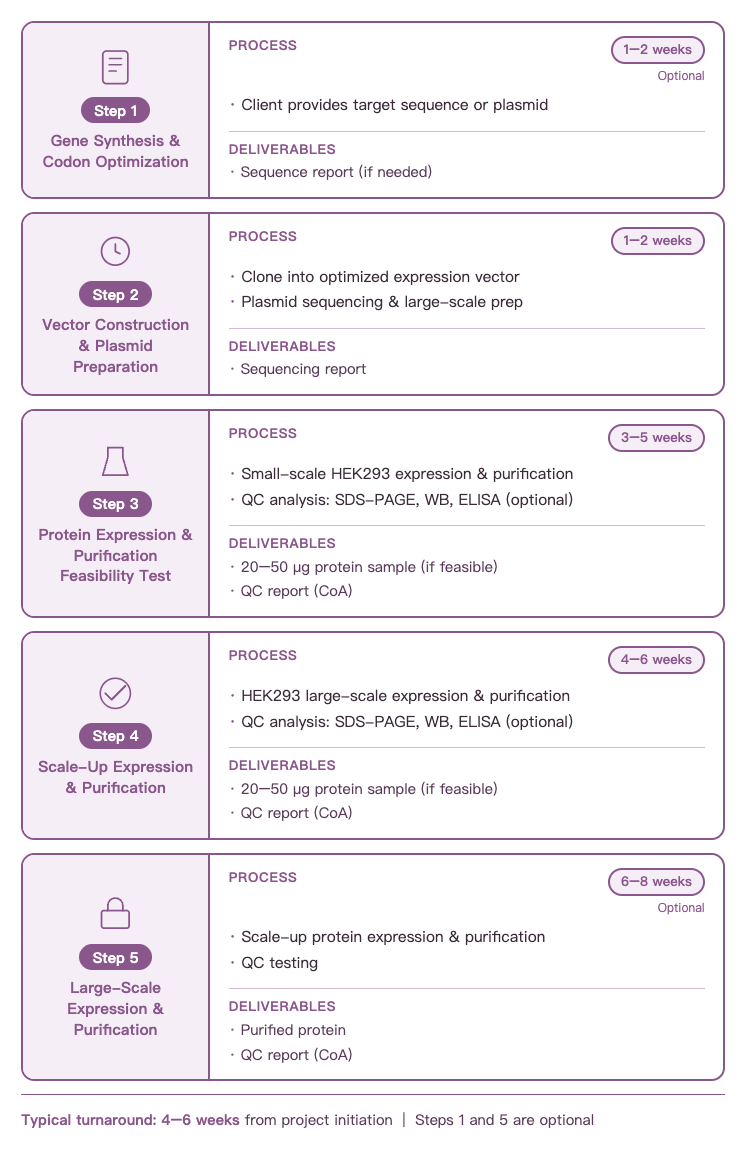
Our modular workflow ensures that you receive thoroughly validated material at each milestone. Whether you require only feasibility testing (Step 3) or full-scale GMP-like preparation (Step 5), BioCrest Sci adapts the process to your research timeline and budget. The integration of detergent screening (as part of Steps 3–4) guarantees optimal micelle formation and functional integrity for your target.
Applications
Structural Biology
Homogeneous, monodisperse preparations for cryo-EM single-particle analysis and X-ray crystallography.
Antibody Discovery & Immunization
Detergent-purified proteins as immunogens for native epitopes; screening antigens in ELISA/binding assays.
Binding Assays & Ligand Characterization
Small molecule binding, radioligand binding, competition assays for drug screening.
Biochemical Characterization
Functional assays, protein-protein interaction, mass spectrometry-based proteomics.
Deliverables
Every completed project includes purified target protein in detergent-containing buffer, accompanied by a full characterization data package: SDS-PAGE purity assessment, SEC-HPLC chromatogram confirming monodispersity, Western blot confirming target protein identity, and BCA total protein quantification. A project report covering expression conditions, detergent selection rationale, purification steps, and QC results is provided as standard. Typical yields range from 50–500 µg depending on target expression level and scale; yield estimates for your specific target will be discussed during project scoping.
Typical turnaround: 4–8 weeks from project initiation, depending on whether detergent screening is required and the complexity of the purification workflow.
FAQ
Both platforms are designed to produce transmembrane protein material, but they differ in format and application profile. The Detergent Platform yields purified soluble protein in detergent micelles — suitable for structural studies, biochemical assays, and applications requiring a defined, homogeneous protein preparation. The VLP Platform presents the protein in a native lipid bilayer on a membrane particle — better suited for immunization campaigns and antibody screening where conformational epitopes and native topology are the priority. Many programs benefit from using both.
It depends on the assay and the detergent. We select detergents with your downstream application in mind and provide full information on the detergent system used, including concentration and CMC, so your team can assess compatibility. For some applications, detergent exchange or removal is possible and can be included as part of the project.
Yes. If you have an existing vector for your target, we can work from it, which may shorten the timeline. We will review the construct design and recommend modifications if needed for optimal expression or purification.
Many transmembrane proteins are inherently low-expressers or unstable outside the membrane. We address this through construct engineering (tag placement, truncation, fusion partners), expression system selection, and lipid supplementation during extraction. We will flag any known challenges for your target during feasibility review and set realistic expectations before work begins. We do not guarantee success for every target.
Endotoxin testing is available as an add-on. Please specify at project scoping if your downstream application requires it.
Get Started
📩 Share your target information and application goals — we'll assess feasibility and provide a project proposal.
Contact BioCrest Sci →