Custom Nanobody Production Services
Nanobodies, also known as VHH antibodies or single-domain antibodies, are antibody fragments naturally derived from heavy-chain–only antibodies found in camelids such as llamas and alpacas. Compared with conventional antibodies, nanobodies offer several advantages, including smaller molecular size, enhanced tissue penetration, high stability, and the ability to recognize cryptic or conformational epitopes that may be difficult to access using traditional IgG antibodies.
At Biocrest Science, we provide flexible nanobody production services designed to support antibody discovery, recombinant expression, and downstream engineering workflows. Our platform integrates camelid immunization, single B cell screening, phage display technologies, recombinant expression, and nanobody optimization strategies to support applications ranging from basic research to early therapeutic development.
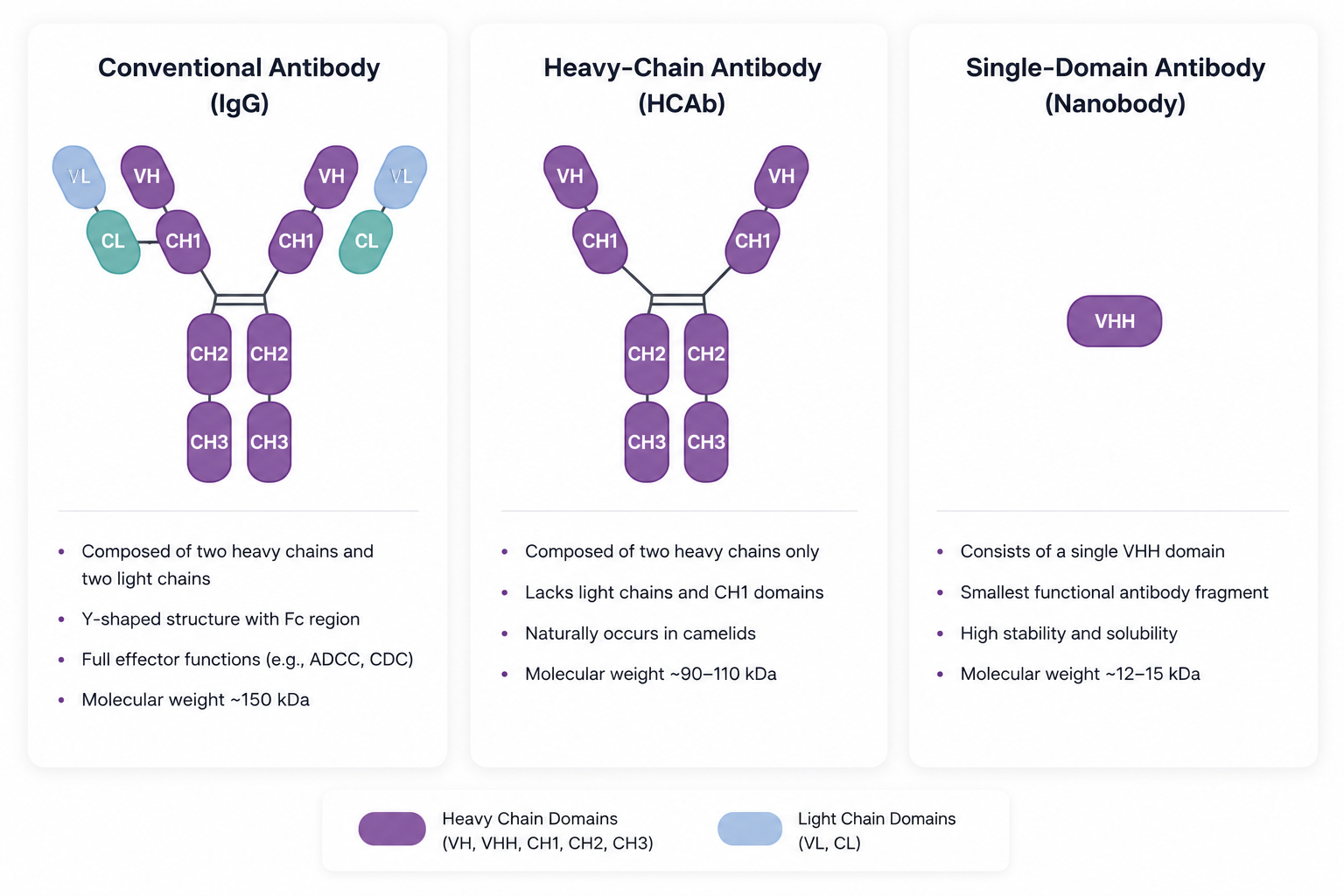
Nanobody Discovery Platforms
Different nanobody generation strategies may be selected depending on antigen type, screening requirements, and downstream applications.
| Platform | Best For | Key Advantages |
|---|---|---|
| Camelid Immunization Platform | High-affinity antigen-specific nanobody discovery | Natural in vivo affinity maturation |
| Phage Display Platform | Difficult or low-immunogenic targets | Large library diversity and in vitro screening |
| Single B Cell Screening Platform | Rapid nanobody lead identification | Preservation of native VHH pairing and fast candidate recovery |
| Synthetic Nanobody Library Screening | Early-stage exploratory projects | No animal immunization required |
Platform selection is typically based on antigen complexity, timeline requirements, and intended downstream applications.
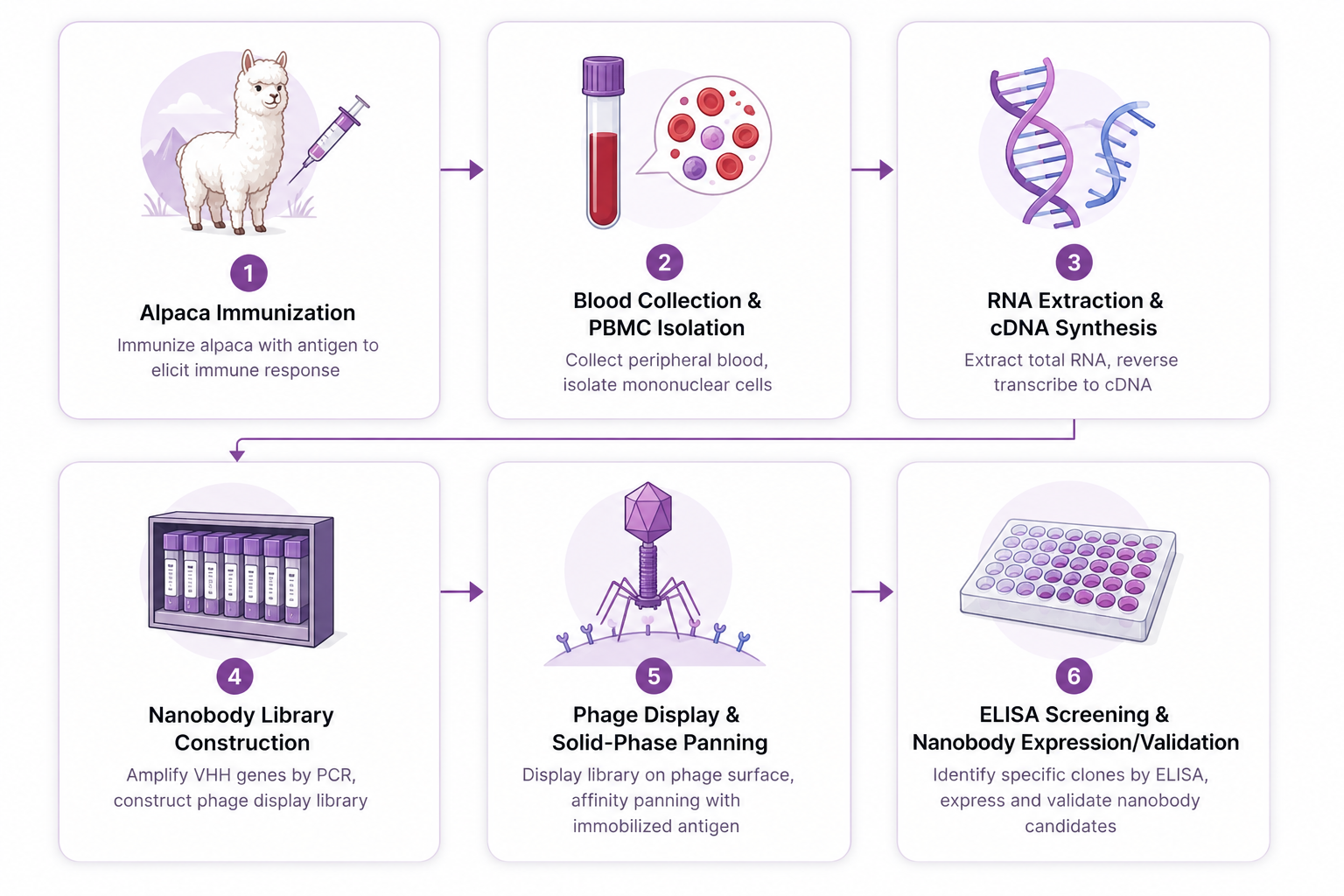
Supported Nanobody Formats
We support production and engineering of multiple nanobody-related formats:
- Monovalent VHH nanobodies
- Multivalent nanobody constructs
- Fc-fused nanobodies
- Bispecific nanobody formats
- Tagged recombinant nanobodies (His, Flag, Fc, etc.)
- Humanized nanobody formats (upon request)
Expression strategies can be adapted for research-use antibodies, assay reagents, or early therapeutic studies.
Applications & Use Cases
Nanobodies generated through our services are commonly used in:
- Diagnostic assay development
- Therapeutic antibody discovery
- Flow cytometry and imaging
- Biosensor and detection platforms
- Intracellular antibody research
- Targeted delivery systems
- Structural biology studies
Application-specific validation is not automatically included for all projects. Validation workflows can be customized based on downstream research requirements and assay needs.
Overview of the Workflow
| Phase | Service | Description | Deliverables | Timeline |
|---|---|---|---|---|
| Phase 1 | Antigen Preparation & Strategy Design | Antigen evaluation and immunization or library screening strategy development | Project design plan | ~1 week |
| Phase 2 | Immunization or Library Construction | Camelid immunization or synthetic/phage library preparation | Immune samples or screening library | 3–6 weeks |
| Phase 3 | Nanobody Screening & Sequencing | Identification and sequencing of antigen-specific VHH candidates | Nanobody sequence data | 1–2 weeks |
| Phase 4 | Recombinant Expression & Purification | Recombinant production of selected nanobody candidates | Purified nanobody samples | 1–2 weeks |
| Phase 5 | Quality Control & Optional Validation | Standard QC and optional functional characterization | QC report, binding data (if requested) | ~1 week |
Typical total timeline: ~6–10 weeks
Timelines may vary depending on antigen properties, screening strategy, and downstream validation requirements.
Expression & Engineering Options
Additional optimization and engineering services are available following nanobody discovery:
- Nanobody humanization
- Affinity maturation
- Fc fusion engineering
- Multivalent nanobody design
- Bispecific nanobody engineering
- Stable cell line development
Expression can be performed in bacterial or mammalian systems depending on nanobody format and application requirements.
Quality & Validation
We implement quality control and analytical workflows appropriate for recombinant nanobody development.
Standard Quality Control
Sequence verification, Purity assessment (SDS-PAGE), Concentration determination
Functional Validation (performed upon request)
ELISA binding analysis, Flow cytometry validation, Neutralization or blocking assays, Comparative antigen-binding studies
Optional Characterization
Affinity measurement (SPR or BLI), Thermal stability analysis, Aggregation analysis
Validation scope is determined during project planning and adjusted based on project objectives.
Why Researchers Choose Biocrest Science
- Integrated nanobody discovery platforms – Support for immunization-based, phage display, and single B cell workflows
- Flexible nanobody engineering capabilities – From monovalent VHHs to Fc-fused and bispecific constructs
- Rapid recombinant expression workflows – Efficient progression from screening to purified nanobody production
- Scientist-led project planning – Customized strategy development based on antigen and application requirements
- Support for translational research workflows – Compatible with discovery-stage and early therapeutic development projects
Because nanobody performance depends on antigen properties, screening conditions, and engineering strategies, project outcomes can vary. Our team works to optimize each stage while maintaining realistic expectations regarding yield, affinity, and downstream functionality.
Start Your Project
Whether you are developing research-use nanobodies, diagnostic reagents, or early therapeutic candidates, our team can help design a workflow aligned with your research goals.
- Submit antigen information or target details for evaluation
- Consult with our scientists on platform and expression strategy selection
- Request a quote based on screening scale and downstream requirements
📩 Typical response time: 1–2 business days
Contact us to discuss your custom nanobody production project.
Contact Biocrest Science →