Custom Polyclonal Antibody Production Services
Biocrest Science provides custom polyclonal antibody production services for academic laboratories, biotechnology companies, diagnostic developers, and pharmaceutical research teams. Our workflows support antibody generation against recombinant proteins, peptides, membrane-associated targets, viral antigens, fusion proteins, and small molecules.
Polyclonal antibodies remain widely used across life science research because they recognize multiple epitopes on a target antigen, which can improve signal sensitivity in applications such as Western blotting, ELISA, immunohistochemistry, and immunoprecipitation. Compared with monoclonal antibody development, polyclonal antibody production generally offers shorter timelines and broader epitope coverage, making it useful for exploratory studies, assay development, and antigen detection workflows.
Biocrest Science offers flexible immunization, purification, and validation strategies designed around the intended downstream application rather than a fixed production template.
Overview of Custom Polyclonal Antibody Production
Polyclonal antibodies are generated by immunizing host animals with a target antigen, leading to activation of multiple B-cell populations that recognize distinct epitopes. The resulting antisera contain heterogeneous antibody populations capable of binding multiple regions of the target molecule.
Custom polyclonal antibody services are commonly used for:
- Western blot antibodies
- ELISA reagent development
- Immunohistochemistry (IHC)
- Immunofluorescence (IF/ICC)
- Immunoprecipitation (IP)
- Chromatin immunoprecipitation (ChIP)
- Flow cytometry
- Pathogen detection assays
- Biomarker research
- Protein localization studies
Because polyclonal antibodies can recognize multiple epitopes simultaneously, they are often selected for low-abundance targets, partially denatured proteins, or applications requiring strong signal intensity.
Available Animal Hosts
Different host species may offer advantages depending on antigen properties, downstream applications, and antibody yield requirements.
| Host Animal | Typical Applications | Key Advantages |
|---|---|---|
| Rabbit | Peptide antibodies, recombinant protein targets, phospho-specific antibodies, low-immunogenicity proteins, general research applications | High-affinity immune response; suitable for small peptides and modified epitopes; relatively fast development timelines; widely compatible with research applications |
| Mouse | Cross-reactivity studies, epitope mapping, small-scale antigen screening, exploratory studies bridging to mouse monoclonal platforms | Mature mammalian immune response; compatible with mouse mAb development workflows; low antigen requirement |
| Goat | Diagnostic assay development, large-scale reagent production, secondary antibody generation, bulk antibody manufacturing | Higher serum yields; long-term production capability; suitable for scale-up projects |
| Sheep | Therapeutic research support, toxin-associated targets, large-scale immunodiagnostic workflows | High-volume antiserum production; supports specialized immunization programs |
| Llama | Single-domain antibody (VHH) development, blood-brain barrier penetration studies, structural biology, detection systems requiring high thermal/chemical stability | Produces unique heavy-chain antibodies (VHH fragments); small size allows recognition of hidden epitopes; high thermal and chemical stability |
| Chicken | Antibody development against highly conserved mammalian proteins, avoiding cross-reactivity with mammalian proteins, IgY for diagnostic or therapeutic research | Phylogenetic distance enables immune response to conserved mammalian antigens; IgY reduces non-specific binding to mammalian Fc receptors |
| Bovine | Large-scale industrial antibody production, passive immunization products, veterinary or therapeutic polyclonal antibody raw materials | Single bleed yields liters of serum; suitable for very large-scale production; can produce immunoglobulin concentrates |
Supported Antigen Types
Biocrest Science supports custom polyclonal antibody generation against a broad range of antigen classes, including:
- Recombinant proteins
- Synthetic peptides
- Fusion proteins
- Membrane proteins
- Viral proteins
- Bacterial antigens
- Cytokines and growth factors
- Phosphorylated peptides
- Haptens and small molecules
- Native or denatured proteins
Where appropriate, our scientific team can assist with antigen design, peptide selection, carrier conjugation strategies, and epitope evaluation before project initiation.
Antigen Design and Immunization Strategy
Successful polyclonal antibody development often depends heavily on antigen quality and immunization design. Before immunization, we evaluate factors such as:
- Antigen purity
- Protein conformation
- Peptide hydrophilicity
- Epitope accessibility
- Species homology
- Post-translational modifications
- Target application requirements
For peptide-based projects, carrier conjugation strategies may be used to improve immunogenicity. Common conjugation carriers include KLH and BSA depending on downstream assay requirements. Immunization schedules are optimized according to antigen type, host species, and expected immune response.
Standard Workflow
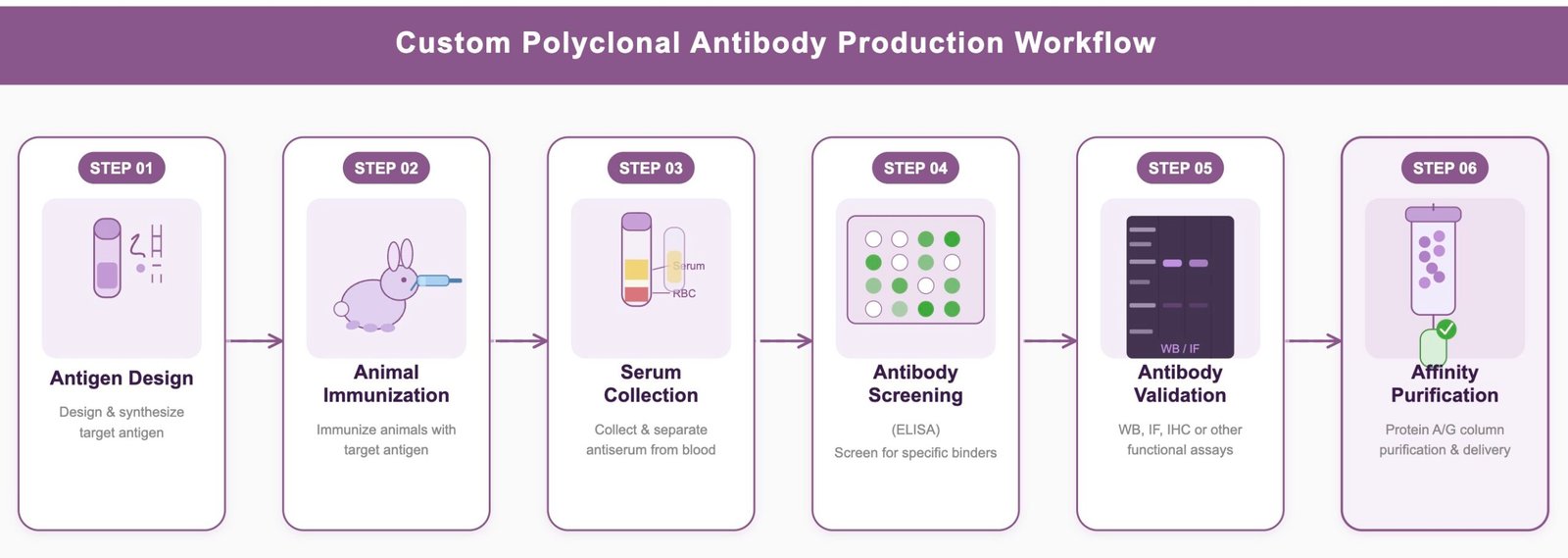
Validation and Characterization Options
Validation strategies can be customized based on downstream application requirements. Available characterization services include:
| Validation Method | Typical Purpose |
|---|---|
| ELISA | Antigen binding assessment |
| Western Blot | Recognition of denatured proteins |
| Immunohistochemistry (IHC) | Tissue staining evaluation |
| Immunofluorescence (IF/ICC) | Cellular localization |
| Flow Cytometry | Cell surface binding |
| Immunoprecipitation (IP) | Protein capture capability |
| Titer Determination | Immune response monitoring |
| Cross-Reactivity Testing | Specificity evaluation |
Application-specific validation is important because antibody performance can vary across sample preparation methods, fixation conditions, and assay formats.
Typical Project Timelines
| Project Stage | Estimated Timeline |
|---|---|
| Antigen review and project setup | 1–2 weeks |
| Immunization phase | 6–12 weeks |
| Test bleed screening | 1–2 weeks |
| Production bleed collection | 1–2 weeks |
| Purification and QC | 1–2 weeks |
Typical rabbit polyclonal antibody projects are often completed within approximately 2–4 months depending on project complexity and immune response.
Quality Control and Scientific Considerations
Polyclonal antibody production is a biological process, and antibody performance may vary depending on antigen design, immunogenicity, host response, and downstream assay conditions. To improve project reliability, Biocrest Science incorporates staged quality control checkpoints throughout development, including:
- Antigen integrity assessment
- Serum titer monitoring
- Specificity screening
- Purification QC
- Contamination testing
- Concentration verification
For technically challenging targets, alternative immunization strategies or additional booster schedules may be recommended during development.
Applications
Our custom polyclonal antibody services support research and development programs in:
- Oncology
- Immunology
- Infectious disease
- Neuroscience
- Stem cell biology
- Biomarker discovery
- Vaccine research
- Translational medicine
- Diagnostic assay development
Why Researchers Work With Biocrest Science
Flexible Antigen Support
We support recombinant proteins, peptides, membrane-associated targets, modified antigens, and complex immunogens.
Application-Oriented Validation
Validation workflows can be aligned with intended downstream applications to help reduce assay redevelopment later in the project.
Scalable Production Options
Projects can range from small exploratory studies to larger-scale antibody production programs.
Technical Scientific Support
Our scientific team works with researchers during antigen planning, immunization strategy design, purification selection, and assay validation planning.
Frequently Asked Questions
Projects can typically begin with purified protein, peptide antigen, conjugated peptide, or antigen sequence information. Antigen preparation support may also be discussed if needed.
Yes. We support multiple strategies for membrane-associated targets, including peptide immunization, extracellular domain antigens, and specialized antigen preparation workflows.
Not always. Crude antisera may be sufficient for some exploratory applications, while affinity purification is commonly preferred for applications requiring lower background and higher specificity.
Yes. Validation services can be customized for Western blot, ELISA, IHC, IF, IP, flow cytometry, and related assay formats.