Full-Length Multi-Transmembrane Protein Expression Platform
A Comprehensive Suite of Seven Platforms for Native-Conformation Transmembrane Protein Production
Transmembrane proteins are the gatekeepers of cellular communication — controlling signal transduction, molecular transport, and cell-cell recognition. They account for more than 60% of all known drug targets, and for antibody drug targets specifically, membrane proteins represent over 90% of the addressable landscape. Yet despite their importance, producing transmembrane proteins in a form that preserves native conformation and functional activity remains one of the most persistent challenges in biologics development.
BioCrest Sci has developed a proprietary full-length multi-transmembrane protein expression platform — a suite of seven complementary production approaches that together cover the full spectrum of membrane protein formats, applications, and downstream needs. Whether you need purified protein for structural studies, native membrane particles for immunization, or functional material for cell-based assays, we have a platform designed for your target.
The Challenge
Full-length multi-pass transmembrane proteins — GPCRs, claudins, ion channels, and transporters — are notoriously difficult to produce outside their native membrane environment. Their hydrophobic transmembrane domains anchor them in the lipid bilayer, and expression levels in standard recombinant systems are typically low. Removing them from the membrane without detergent disrupts their three-dimensional structure, destroying the conformational epitopes that matter most for antibody drug discovery. For single-pass membrane proteins, extracellular domain (ECD) expression is often sufficient — but for targets with multiple transmembrane helices, that approach captures only a fraction of the biologically relevant epitope space.
The result is a persistent gap between the targets researchers want to study and the tools available to study them. BioCrest Sci's platform was built specifically to close that gap.
Our Solution — Seven Platforms, One Unified Workflow
BioCrest Sci's full-length multi-transmembrane protein expression platform is built on the HEK293 mammalian expression system, which produces proteins with native-like post-translational modifications, correct glycosylation, and near-physiological folding. The platform divides into two major categories — purified membrane protein platforms and non-purified membrane protein platforms — giving researchers the flexibility to match their production format to their downstream application.
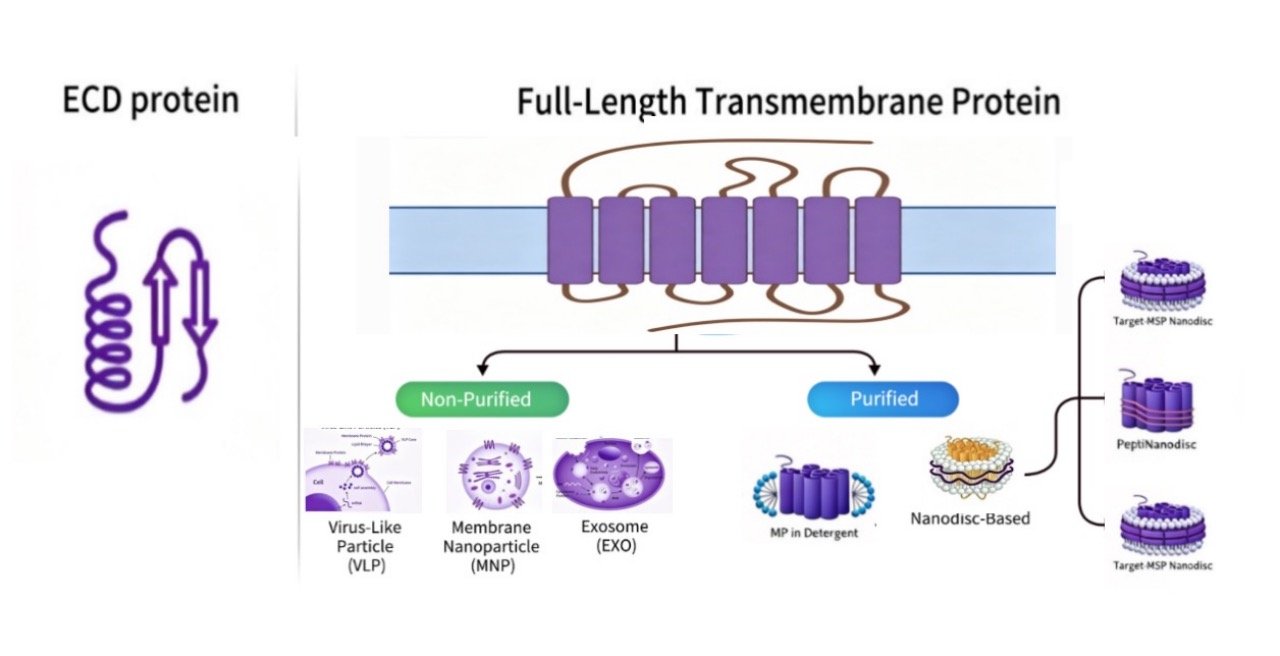
Purified Membrane Protein Platforms
These platforms yield isolated, soluble transmembrane protein preparations suitable for structural biology, binding assays, and biochemical characterization.
1. Synthetic Nanodisc Platform
Transmembrane proteins are reconstituted into defined phospholipid nanodiscs using membrane scaffold protein (MSP). Ideal for cryo-EM structural studies and SPR/BLI binding assays requiring both faces of the protein accessible.
2. MSP Nanodisc Platform
Uses native MSP scaffold variants for targets with specific membrane curvature or lipid composition requirements. Particularly suited to targets with known lipid dependencies.
3. PeptiNanodisc Platform
Uses short amphipathic peptides instead of full MSP belts to stabilize smaller, more flexible lipid discs. Enables reconstitution of targets that are difficult to incorporate using standard MSP-based methods.
4. Detergent Platform
Classical detergent-based solubilization and affinity purification of transmembrane proteins from HEK293 membranes. A practical, established approach for antibody screening antigens and biochemical characterization where mild detergent is acceptable.
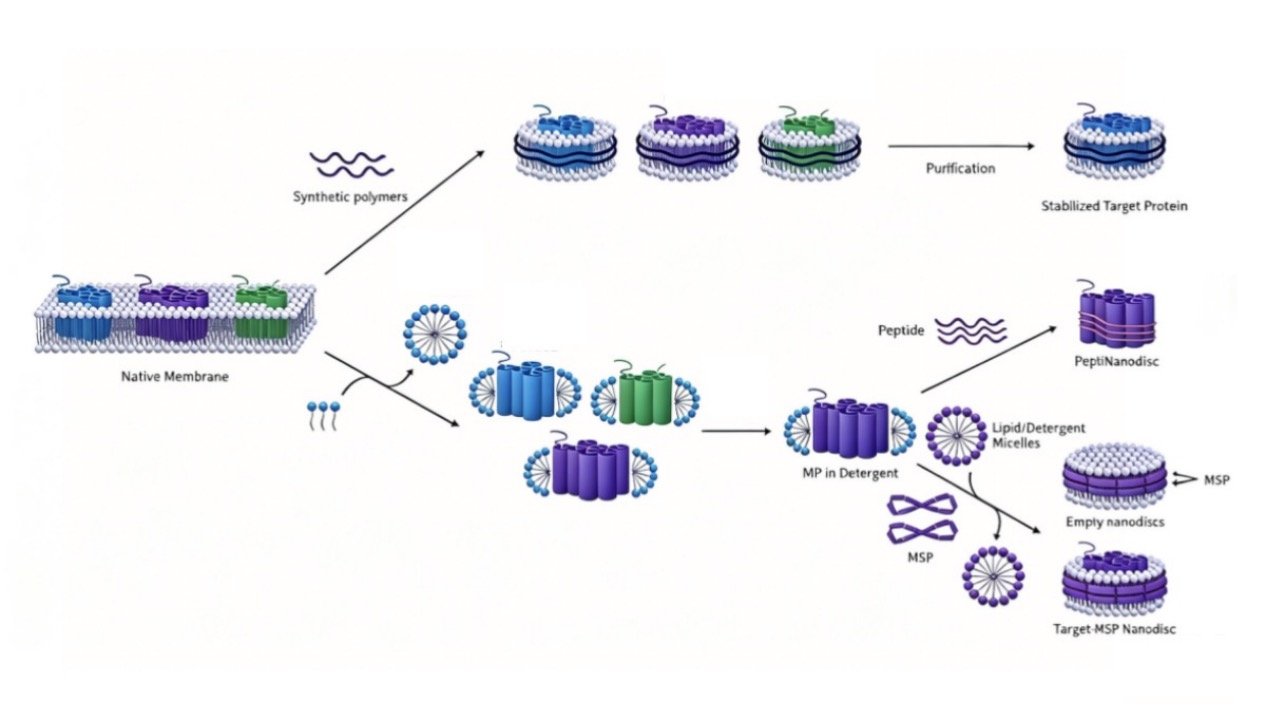
Detergent vs. Nanodisc — Comparative Parameters
| Parameter | Detergent | Nanodisc |
|---|---|---|
| Included formats | — | Synthetic Nanodisc / MSP Nanodisc / PeptiNanodisc |
| Membrane Stabilizer | Detergent | Polymer (Synthetic) / MSP (MSP Nanodisc) / Peptide (PeptiNanodisc) |
| Nanodisc Diameter | Theoretically unlimited | ~10nm (Synthetic) / 7-17nm (MSP) / Theoretically unlimited (Pepti) |
| Phospholipid Source | None | Natural phospholipids (Synthetic) / Synthetic phospholipids (MSP) / Small amount of natural phospholipids (Pepti) |
| Preparation Method | Add detergent to replace phospholipids, then purify | Synthetic: addition of polymer in membrane extract MSP: cell-free system / detergent purification + assembly Pepti: post-detergent peptide addition |
| Contains Detergents? | Yes | No (Synthetic) / Possible trace amounts (MSP/Pepti) |
| Quantitative Target Protein? | Yes | Yes (Synthetic) / No (MSP/Pepti) |
| Acid and Divalent Metal Ion Tolerant? | Yes | No (Synthetic) / Yes (MSP/Pepti) |
| Applications | ELISA / SPR / BLI / Cryo-EM / Phage Display | Immunoassay / ELISA / SPR / BLI / Cryo-EM / Phage Display / Cell experiments (Pepti) |
Non-Purified Membrane Protein Platforms
These platforms present transmembrane proteins in their native membrane context — without detergent extraction — making them particularly effective for immunization and functional assays.
5. MNP — Membrane Nanoparticle Platform
Membrane nanoparticles derived from cell membranes carry your target protein in a native lipid environment with no detergent extraction. Highly effective for generating antibodies against conformationally sensitive epitopes.
6. VLP — Virus-Like Particle Platform
Co-expression of HIV-1 gag drives VLP budding from producer cells, incorporating your transmembrane protein into the outer surface of enveloped particles. Well established for GPCR, claudin, and viral antigen immunization campaigns.
7. Exosome Platform
Naturally secreted exosomes from HEK293 producer cells overexpressing your target carry the protein in a native membrane context. Effective for generating high-quality antibody responses against difficult multi-pass targets.
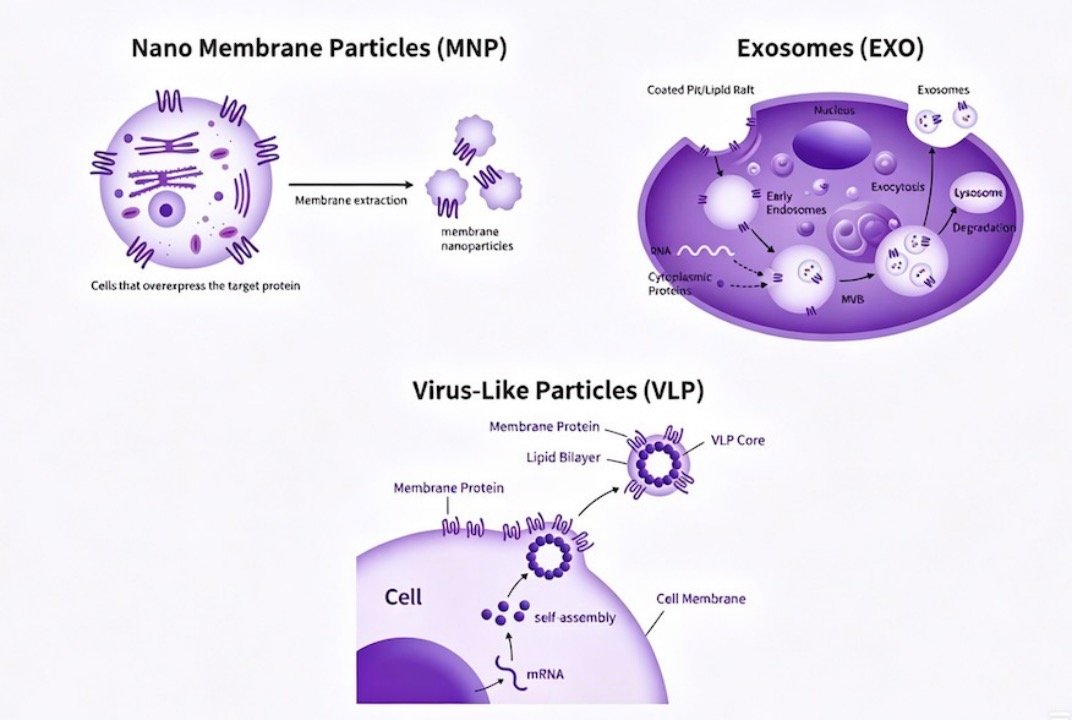
Non-Purified Platform Comparison
| Parameter | VLP | MNP | Exosome |
|---|---|---|---|
| Membrane Stabilizer | Viral core protein (HIV-1 gag) | None (native cell membrane) | None (native exosome membrane) |
| Particle Diameter | 100-150nm | 50-200nm | 30-150nm |
| Phospholipid Source | Host cell membrane | Host cell membrane | Host cell membrane |
| Preparation Method | Co-expression of target + HIV-1 gag drives VLP budding | Membrane fragmentation from target-overexpressing cells | Natural secretion from target-overexpressing HEK293 cells |
| Contains Detergents? | No | No | No |
| Quantitative Target Protein? | Semi-quantitative (ELISA/NTA) | Semi-quantitative | Semi-quantitative |
| Acid and Divalent Metal Ion Tolerant? | Yes | Yes | Yes |
| Applications | Immunization / Antibody discovery / ELISA / FACS | Immunization / Conformation-sensitive epitopes / Functional assays | Immunization / Immunostimulation / Antibody discovery |
Key Applications
- Immunogen for therapeutic antibody discovery — All seven platforms can serve as immunogens. Non-purified platforms (VLP, MNP, Exosome) are particularly effective for raising antibodies against conformationally sensitive multi-pass targets.
- Ligand–receptor binding studies — Purified nanodisc and detergent preparations support quantitative SPR/BLI binding studies for targets that cannot be studied as truncated ECDs.
- Preclinical in vitro functional studies — MNP and Exosome preparations support cell-free functional assays including GPCR signaling and transporter activity studies.
- Protein function testing — Nanodisc-reconstituted proteins enable biochemical characterization of target activity and protein–protein interactions in a defined membrane environment.
Supported Target Classes
- G protein-coupled receptors (GPCRs) — Class A, B, C, and Frizzled family
- Claudins (CLDN6, CLDN18.1, CLDN18.2, and others)
- Ion channels (voltage-gated and ligand-gated)
- Solute carriers (SLC transporters)
- Viral envelope glycoproteins and spike proteins
- Tumor-associated membrane antigens
Deliverables
- Purified protein or membrane particle preparation in appropriate buffer
- SDS-PAGE and/or Western blot confirming target protein presence
- Functional binding validation data (ELISA or equivalent)
- Particle characterization data where applicable (NTA, TEM, DLS)
- QC report (CoA) covering production conditions and analytical results
Get Started
Share your target, your application, and your timeline. Our scientists will recommend the most appropriate platform, assess feasibility, and provide a detailed project proposal.