Synthetic Nanodisc Platform — Displayed Transmembrane Proteins
Transmembrane proteins lose their native conformation when removed from the lipid bilayer. Detergent micelles can substitute for the membrane in the short term, but many proteins are unstable in detergent for the hours or days required for downstream assays, structural studies, or antibody screening campaigns. Reconstitution into lipid vesicles preserves the membrane environment but restricts access to one face of the protein — making it impractical for assays that require access to both extracellular and intracellular surfaces simultaneously. For researchers studying GPCRs, ion channels, and transporters, this creates a persistent gap between the biology they want to study and the tools available to study it.
Nanodiscs are small, discoidal lipid bilayer particles — typically 7–16 nm in diameter — that hold a defined patch of phospholipid bilayer in solution. The membrane scaffold protein (MSP), derived from human apolipoprotein A-I, wraps around the hydrophobic edge of the lipid disc as an amphipathic belt, stabilizing the structure without blocking access to either face of the bilayer.
To incorporate your target transmembrane protein, we first express and purify it in detergent, then mix it with MSP and a defined phospholipid composition. As detergent is removed — typically using hydrophobic Bio-Beads — the lipids, MSP, and your target protein self-assemble into stable nanodisc particles, which are subsequently purified by size-exclusion chromatography to achieve a monodisperse preparation.
The result is a soluble, defined, detergent-free particle containing your transmembrane protein in a native-like lipid bilayer, accessible from both faces, and compatible with a wide range of downstream analytical and functional applications.
Beyond the MSP-based reconstitution route described above, our platform also supports the styrene‑maleic acid (SMA) copolymer method. SMA can directly insert into native cell membranes, “cutting out” the membrane protein together with its surrounding native lipids to form nanodisc particles — entirely without detergent solubilization or exogenous MSP addition. This route is especially valuable for targets that are sensitive to detergents or that struggle to maintain activity in recombinant lipid environments.
The diagram below illustrates the core steps of SMA‑based nanodisc preparation:
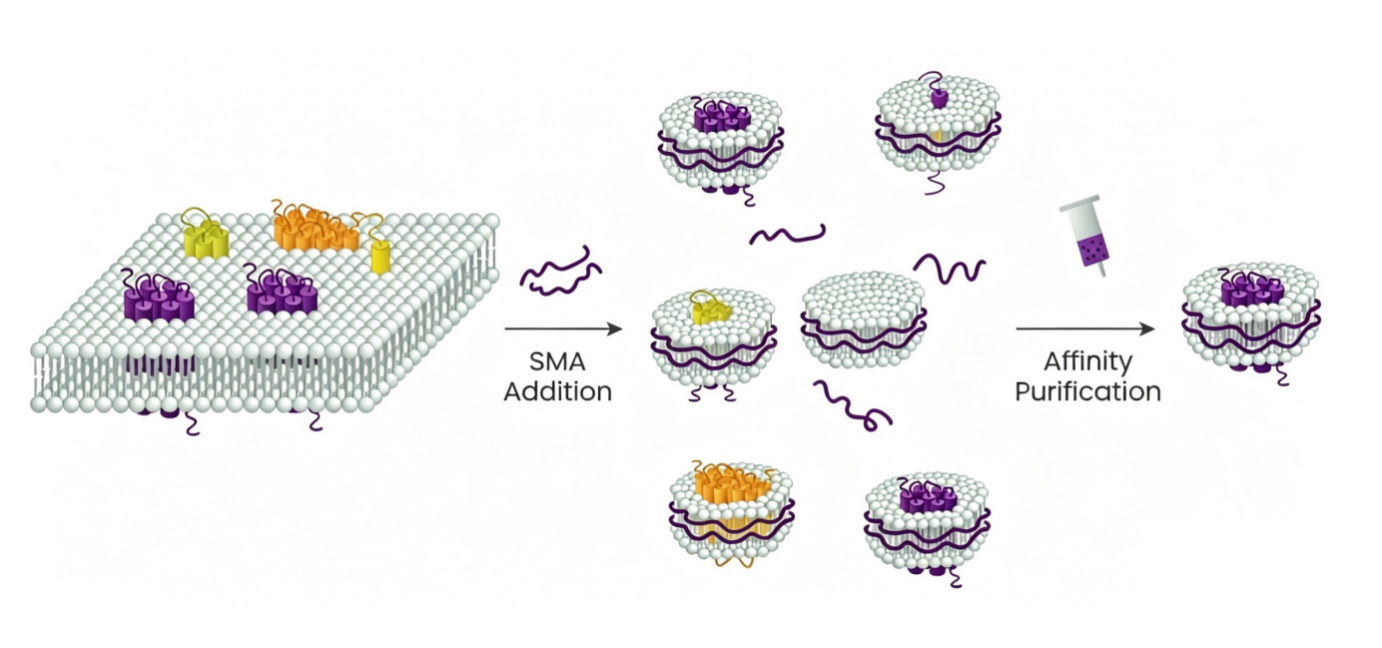
Regardless of whether you choose the MSP route or the SMA route, the final output is a soluble, defined, detergent‑free nanodisc particle containing your transmembrane protein in a native‑like lipid environment — accessible from both sides of the bilayer.
End-to-end production from expression construct through purified nanodisc preparation. Includes target protein expression in HEK293 cells, detergent solubilization, MSP and lipid selection, reconstitution, and SEC-based purification of the final nanodisc complex.
Supported targets: GPCRs, claudins, ion channels, solute carriers (SLCs), viral envelope proteins, and other single- or multi-pass transmembrane proteins.
For targets that require a specific membrane environment, we screen MSP variants and lipid compositions to identify conditions that maximize reconstitution efficiency and protein stability. This is particularly relevant for targets with known lipid dependencies such as cholesterol-sensitive GPCRs or lipid-regulated ion channels.
If you have purified transmembrane protein in detergent and wish to proceed directly to nanodisc reconstitution, we offer reconstitution as a standalone service using your supplied material.
For novel or uncharacterized targets, we offer a pilot-scale reconstitution to assess assembly efficiency and nanodisc homogeneity before committing to preparative-scale production.
Once reconstitution conditions are established, we scale production to meet the quantities required for structural studies, immunization campaigns, or large-format screening panels.
The diagram below summarizes the end‑to‑end workflow from gene synthesis to purified nanodisc delivery. Every project follows this modular design — gene synthesis (Step 1) and large‑scale production (Step 5) are optional, depending on your starting material and required yield.
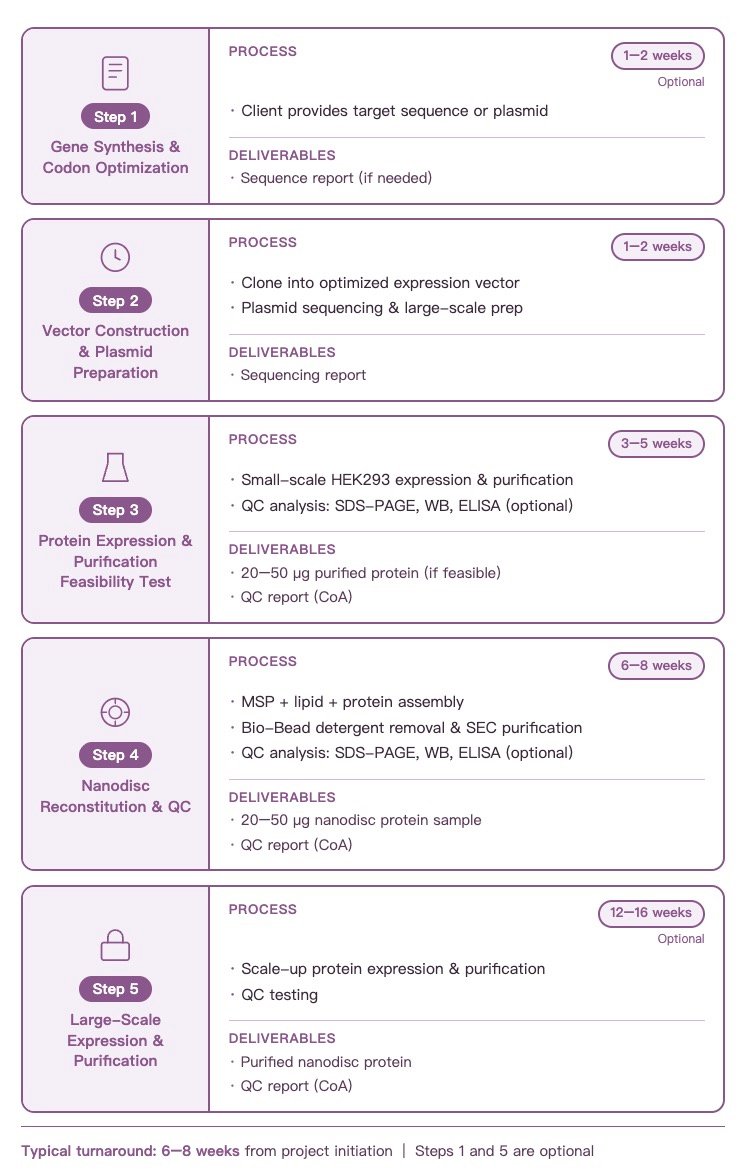
Typical turnaround: 6–8 weeks from project initiation for standard targets with confirmed expression; novel or difficult targets requiring optimization may extend the timeline. As illustrated, if you already have an expression plasmid (skip Step 1) or only need small-scale material for feasibility (Step 3–4), the timeline can be shortened accordingly.
Nanodiscs are an established sample preparation format for cryo-EM single-particle analysis. The defined disc geometry, controlled size, and detergent-free environment are all advantages for grid preparation and particle picking.
Nanodisc-reconstituted proteins present transmembrane targets in a native-like bilayer with both extracellular and intracellular epitopes accessible — ideal immunogens and screening antigens.
Nanodisc preparations support SPR, BLI, and other surface-based binding assays; both sides accessible for studying G proteins, arrestins, and intracellular modulators.
For ion channels and transporters, nanodisc reconstitution can support ligand competition assays and electrophysiology-compatible sample preparation.
Protein-protein interaction studies, mass spectrometry, and thermostability assays.
Typical turnaround: 6–8 weeks from project initiation for standard targets with confirmed expression; novel or difficult targets requiring optimization may extend the timeline.
How is the Synthetic Nanodisc Platform different from your VLP Platform and Detergent Platform?
All three platforms produce transmembrane protein material, but differ in format and application profile. The Detergent Platform yields purified protein in detergent micelles — fastest path, best for structural studies where detergent is acceptable. The VLP Platform presents protein in a native lipid bilayer on a membrane particle — optimal for immunization and antibody screening. The Nanodisc Platform provides a detergent-free lipid bilayer environment with access to both faces of the protein — best for functional studies, interaction assays requiring intracellular access, and cryo-EM structural work. Many programs use more than one platform at different stages.
Can I choose the lipid composition of the nanodisc?
Yes. We can discuss lipid composition based on your target biology and application. Common choices include POPC, POPE, POPG, and cholesterol-containing mixtures. For targets with known lipid dependencies, we can run a small-scale lipid screening experiment as part of the project.
What is the typical yield?
Nanodisc yields depend on the expression level of your target protein and the efficiency of reconstitution. Typical deliveries range from 20–200 µg of nanodisc preparation. Yield estimates for your specific target will be discussed during project scoping based on pilot expression data.
Can both sides of the transmembrane protein be accessed in the nanodisc?
Yes. This is one of the key advantages of nanodiscs over proteoliposomes and VLPs. Because the protein is held in a small, soluble disc rather than a closed vesicle, both the extracellular and intracellular surfaces are freely accessible.
Do you guarantee successful reconstitution for every target?
We cannot guarantee success for every target. Some transmembrane proteins are difficult to express at sufficient levels for reconstitution, and some do not efficiently incorporate into nanodiscs under standard conditions. We conduct a feasibility assessment before committing to full-scale production, and we communicate honestly about any challenges that arise during the project.
Tell us your target, the lipid environment you need, and your downstream application — we will respond with a feasibility assessment and project proposal.