Cell-Free Protein Expression Service
Biocrest Science provides cell-free protein expression services using E. coli-based in vitro transcription-translation systems for rapid recombinant protein production, protein screening, and difficult-to-express target evaluation. Cell-free expression systems enable protein synthesis directly from DNA templates without the need for living cell culture. Compared with conventional bacterial or mammalian expression workflows, in vitro expression can significantly reduce experimental timelines while supporting rapid construct screening, toxic protein expression, isotope labeling, and high-throughput protein production.
What Is Cell-Free Protein Expression?
Cell-free protein expression, also known as in vitro protein synthesis (IVPS) or cell-free protein synthesis (CFPS), uses cellular extracts containing transcriptional and translational machinery to produce recombinant proteins outside living cells. Depending on the extract source, cell-free systems are mainly classified into three major types:
Source: E. coli cell extract
Advantages: High yield · Fast reaction · Lower cost
Typical Applications: Prokaryotic proteins, toxic proteins, high-throughput screening
Source: Wheat germ extract
Advantages: Proper folding of eukaryotic proteins · excellent solubility
Typical Applications: Structural biology, protein-protein interaction, kinase research
Source: Anemic rabbit reticulocyte extract
Advantages: Mammalian-like translation environment · partial post-translational modifications
Typical Applications: Cancer research, viral proteins, functional genomics
Comparison of Three Cell-Free Expression Systems
| Feature | E. coli System | Wheat Germ System | Rabbit Reticulocyte System |
|---|---|---|---|
| Origin | Prokaryotic | Eukaryotic (plant) | Eukaryotic (mammalian) |
| Protein Folding Capacity | Basic level | Good, favors solubility | Good |
| Yield | High | Moderate | Low to moderate |
| Reaction Cost | Low | Moderate | High |
| Suitable Protein Types | Prokaryotic, toxic proteins, enzymes | Full-length eukaryotic proteins, kinases | Mammalian proteins, viral proteins |
| Post-Translational Modifications | None | Limited (e.g., phosphorylation) | Partial (e.g., phosphorylation, acetylation) |
| Typical Applications | High-throughput screening, synthetic biology | Structural biology, protein interactions | Cancer research, functional genomics |
Why Researchers Use Cell-Free Expression Systems
Protein expression can often begin within hours after template preparation, greatly reducing overall timeline compared with traditional cloning and cell culture workflows.
Because no living host cells are required during expression, proteins that impair cell viability or metabolism may be more accessible using in vitro systems.
Cell-free systems are well suited for rapid parallel testing of multiple constructs, mutants, or expression conditions.
Researchers can directly manipulate reaction components, cofactors, detergents, isotopes, or chaperones during protein synthesis.
Expression can be performed from plasmid DNA, linear PCR products, synthetic gene fragments, or mRNA templates.
Our E. coli Cell-Free Expression Platform
Biocrest Science uses optimized E. coli-based cell-free systems for rapid recombinant protein production and expression feasibility studies. The platform is commonly used for: enzyme expression, protein domain screening, membrane protein expression, toxic proteins, isotope-labeled proteins, rapid antigen production, protein engineering workflows, and cell-free synthetic biology studies.
Depending on project requirements, workflows may be configured for: soluble protein expression, total protein yield optimization, rapid construct screening, small-scale functional testing, and downstream purification compatibility.
Typical Cell-Free Expression Workflow
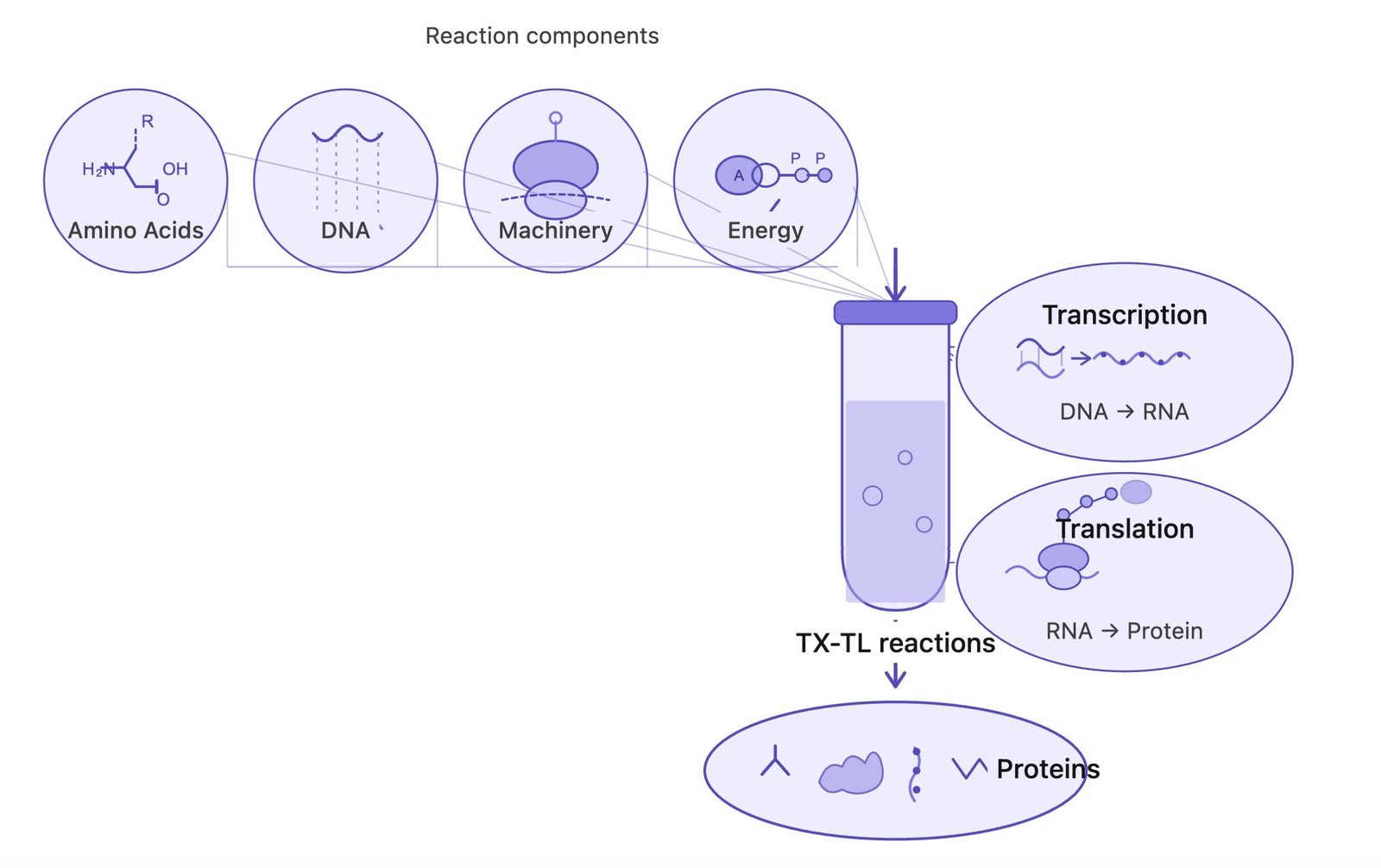
Cell-Free vs Traditional Protein Expression Systems
| Feature | Cell-Free Expression | Conventional E. coli Expression | Mammalian Expression |
|---|---|---|---|
| Typical Timeline | Hours to days | Days to weeks | Weeks |
| Requires Cell Culture | No | Yes | Yes |
| Suitable for Toxic Proteins | Strong advantage | Often challenging | Moderate |
| High-Throughput Screening | Excellent | Moderate | Limited |
| Post-Translational Modifications | System-dependent | Limited | Strong |
| Scale-Up Potential | Moderate | Strong | Strong |
| Open Reaction Control | Excellent | Limited | Limited |
| Typical Yield | Low to moderate | Moderate to high | Variable |
Applications of Cell-Free Protein Expression
Widely used for evaluating multiple constructs before transitioning to larger-scale expression workflows.
Membrane-active proteins, nucleases, and toxic enzymes may express more efficiently in vitro than in living bacterial hosts.
Cell-free systems can support membrane protein synthesis in the presence of detergents, liposomes, or nanodiscs.
Isotope labeling, domain screening, or rapid production of proteins for crystallography/NMR studies.
Cell-free transcription-translation systems are commonly used for prototyping genetic circuits and engineered biological systems.
Accelerate rapid mutant generation and functional testing using in vitro protein synthesis.
Membrane Protein Cell-Free Expression Support
Membrane proteins remain challenging targets in conventional recombinant expression systems. Cell-free platforms can offer advantages because reaction conditions can be directly modified during synthesis. Optimization strategies may include: detergent supplementation, nanodisc incorporation, liposome-assisted folding, chaperone addition, and redox optimization. Actual expression performance varies significantly depending on target complexity and construct design.
Protein Purification and Characterization Options
| Service | Purpose |
|---|---|
| Affinity Purification | Tagged protein isolation |
| SDS-PAGE Analysis | Expression assessment |
| Western Blot | Protein confirmation |
| LC-MS | Molecular characterization |
| Activity Assays | Functional evaluation |
| Solubility Analysis | Fractionation assessment |
| Endotoxin Testing | Downstream assay suitability |
Typical Project Timeline
| Project Stage | Estimated Timeline |
|---|---|
| Template review and project setup | 2–5 business days |
| DNA preparation or cloning | 1–2 weeks |
| Cell-free expression screening | 2–7 days |
| Optimization and repeat expression | 1–2 weeks |
| Purification and QC | 3–7 days |
Many exploratory cell-free expression projects can be completed within approximately 1–3 weeks once templates are available.
Technical Considerations and Limitations
Although cell-free systems provide substantial flexibility, they are not universally optimal for all recombinant proteins. Potential limitations may include: lower total yields compared with fermentation; limited complex post-translational modifications (system-dependent); higher reagent costs at large scale; protein instability in some reaction conditions; and scalability constraints for certain production goals. For proteins requiring extensive glycosylation or complex mammalian folding pathways, insect or mammalian expression systems may be more appropriate.
Why Researchers Work With Biocrest Science
Cell-free systems can help evaluate construct performance quickly before committing to larger expression campaigns.
Reaction conditions can be customized according to protein characteristics, downstream assays, and project objectives.
We provide three major cell-free expression systems: E. coli, wheat germ, and rabbit reticulocyte, recommending the most suitable system for your protein type and downstream applications.
Workflows for toxic proteins, aggregation-prone targets, membrane proteins, and challenging enzymes.
In addition to cell-free systems, Biocrest Science supports bacterial, yeast, insect, and mammalian protein expression workflows.
Frequently Asked Questions
If you are evaluating in vitro protein synthesis for rapid recombinant protein production or difficult target screening, Biocrest Science can help assess construct strategy, expression feasibility, and downstream workflow requirements.